Installation planning
Pico can be installed in various ways. Here you will find the most common variants described along with their specific requirements.
General installation notes
-
Every Pico has DC fault detection according to IEC62955.
-
Pico charging stations with year of manufacture 2024 or from serial number 7002702 have an integrated compliant RCD Typ-A according to IEC60947-2. - from 2024 or serial number 7002702, a series RCD Typ-A is no longer required - before 2024 or serial number 7002702, a series RCD Typ-A is required upstream of each charging station for NIN compliance.
-
The Pico charging stations can handle short-circuit currents of 3kA on their own without any problem. If several charging stations are connected to one outgoing circuit, a miniature circuit breaker must be used on the outgoing circuit. The overcurrent protection device must be rated for the short-circuit capacity of the outgoing circuit. Variants with at least 6kA are recommended in every case.
-
The internal overcurrent protection device of the Pico charging station meets the requirements of IEC 61851-1.
-
Suitable for: Flat ribbon cable installations Busbar installations Looped-through installations Stand installations
-
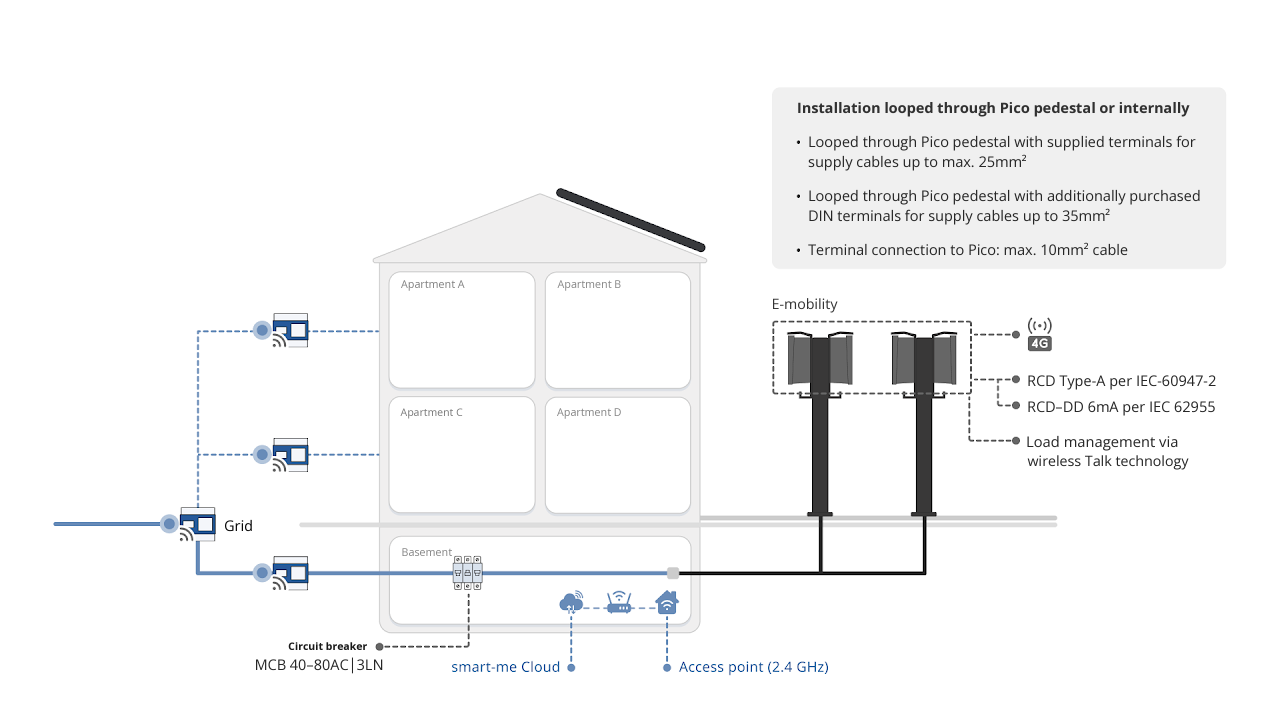
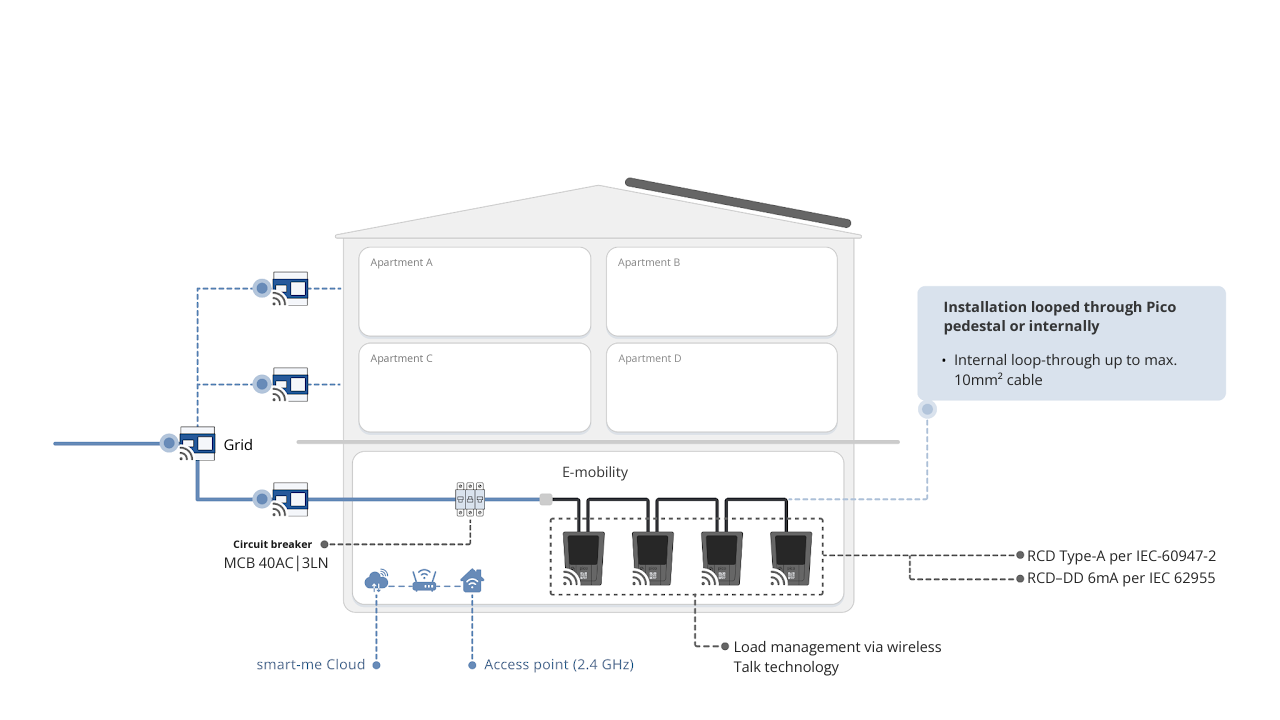
Outgoing circuits up to max. 80A can be connected directly without further measures.
Pico charging station from year of manufacture 2024 and serial number 7002702
All Pico charging stations from serial number 7002702 have an internal RCD Typ-A according to IEC 60947-2 in combination with DC fault protection detection according to IEC62955.
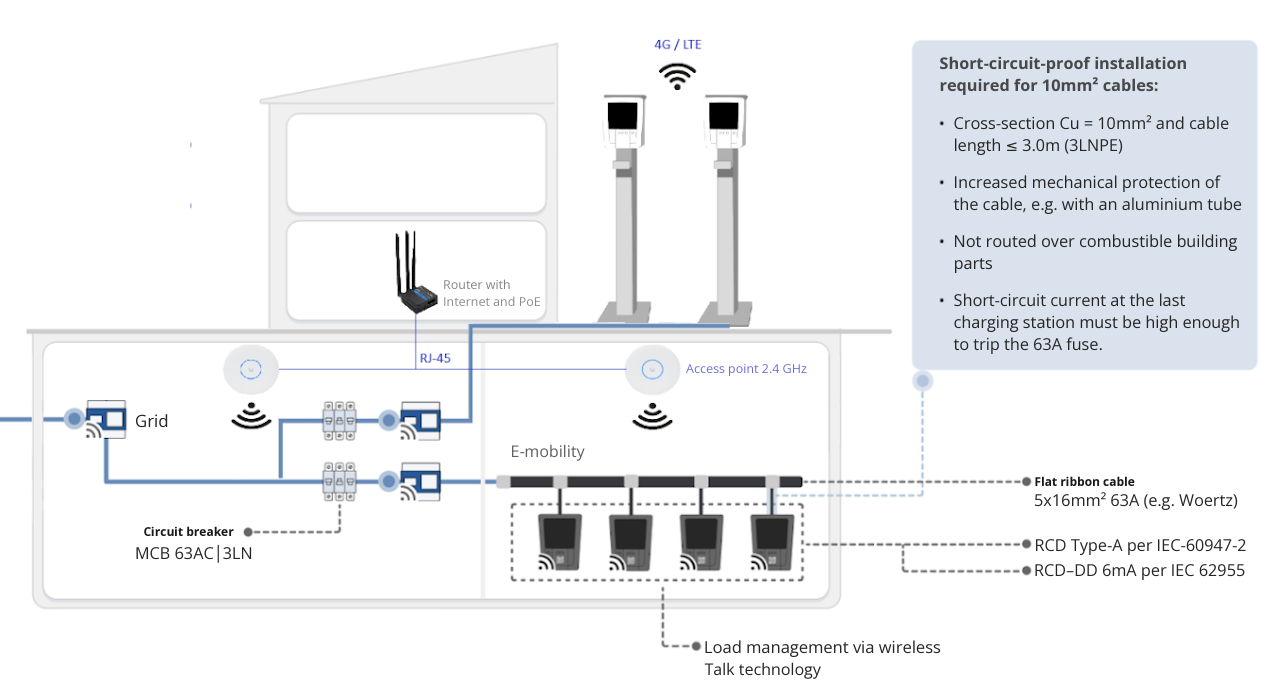
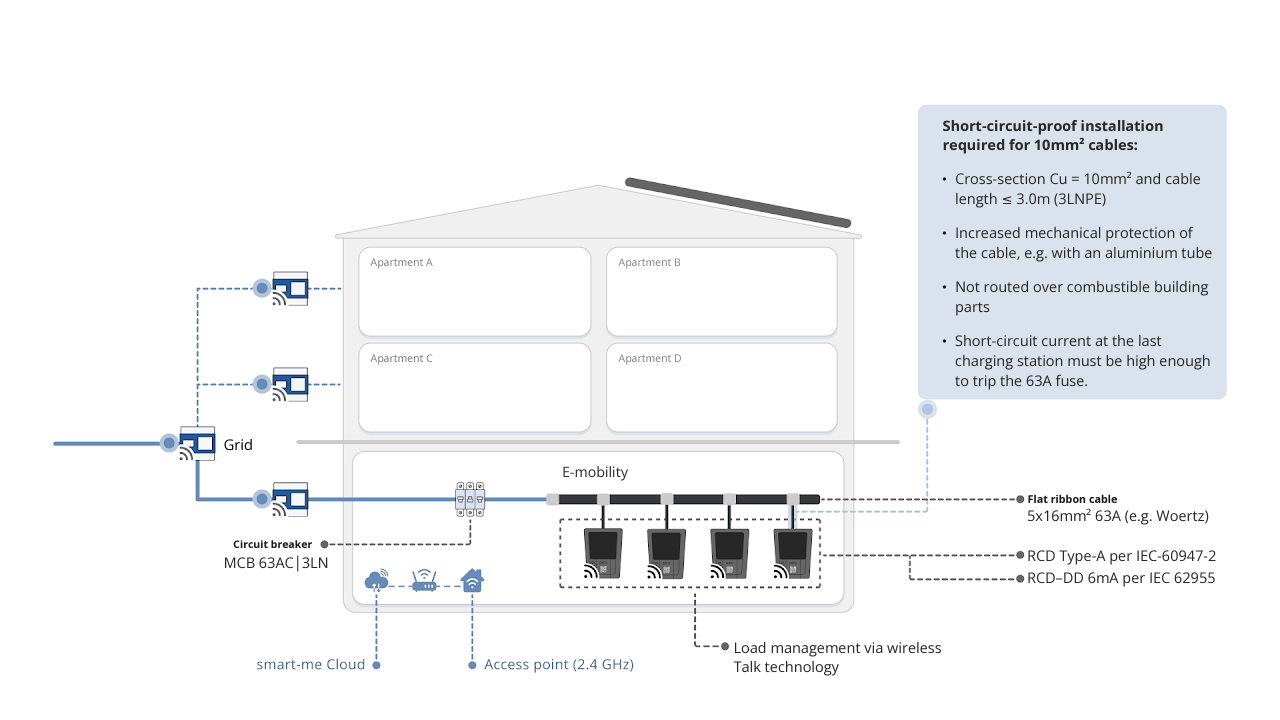
Pico installation on flat ribbon cable or with busbar systems
Note:
The short-circuit current only needs to be checked at the Pico base plate, not at the output / Type 2 of the Pico device.
Pico internally looped-through installation or with Pico Stand Basic (212070-PL)
Pico installation with Pico Stand with service cover (232070-PL)
Lightning protection for outdoor installations of charging infrastructure
-
For stand installations, make sure to also observe the NIN and local regulations regarding lightning protection devices for outdoor installations of charging infrastructure. Swiss NIN chapter: 5.3.4 Germany standard: VDE 0100-534
-
The Pico has overvoltage category 3 (4kV)
-
For installations requiring an SPD Type 2 lightning protection device, stands with service flaps must be provided. The lightning protection device can be installed directly inside.
-
The effective range of an SPD Type-2 is a radius of approx. 10m.
General lightning protection rules as of 04.2025
For buildings without external lightning protection: (e.g. an air-termination system on the roof)
For devices of overvoltage category III, protection by an SPD Type 2 is required so that the impulse withstand voltage of the devices is not exceeded.
For buildings with external lightning protection: (e.g. an air-termination system on the roof) Here the installation requires SPD Type-1 lightning protection and Type-2 lightning protection; otherwise there is a risk that the SPD Type-2 will be destroyed if lightning strikes the air-termination system.
Downloads
Connection diagram and circuit diagram ZIP files
FAQ
Pico charging station before year of manufacture 2024 and serial number 7002702
-
Pico charging stations before year of manufacture 2024 or serial number 7002702 have integrated DC fault detection according to IEC62955.
-
Pico charging stations before year of manufacture 2024 or serial number 7002702 have a functional but not 100% compliant residual current detection for AC currents Type-A (30mA)
Flat ribbon cable installation
-
RCD Typ-A 40A without MCB in series with each Pico charging station
-
A circuit breaker on the e-mobility outgoing circuit with short-circuit-proof installation method (blue box) is sufficient for selectivity. (Extended documentation)
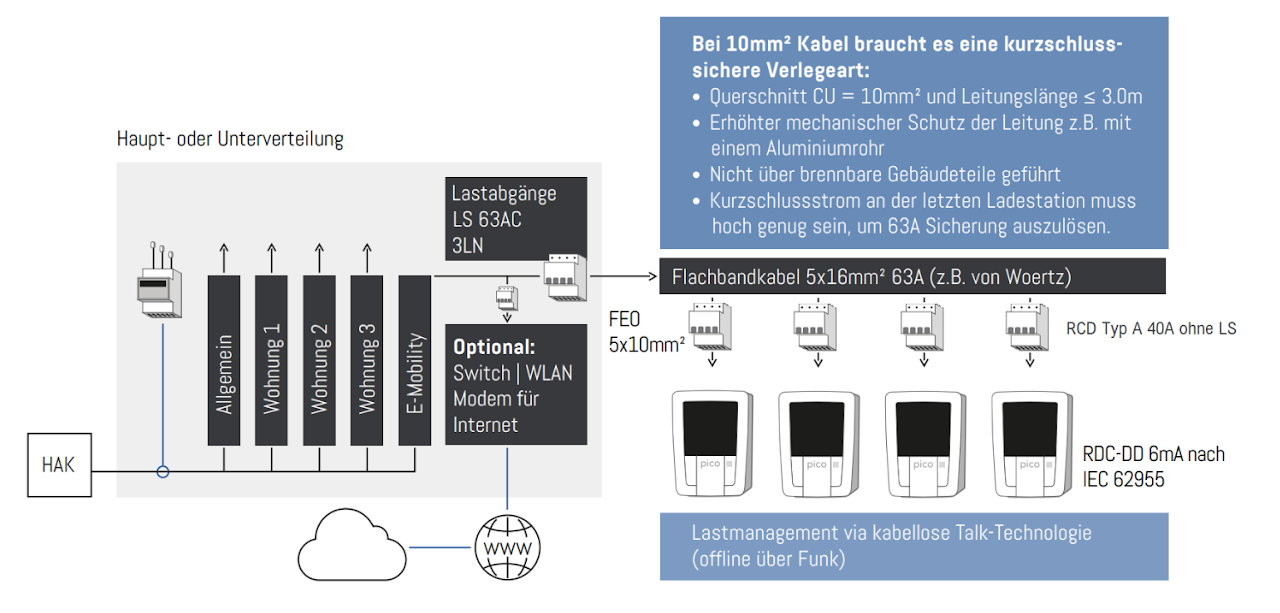
Overcurrent protection for charging station group protection and supply line up to 80A per phase
The overcurrent protection on the outgoing circuit for the entire charging group should have characteristic C. The usual overcurrent protection devices with characteristic B are not suitable for charging station installations and tend to trip too early.
For a 63A e-mobility outgoing circuit, for example, a 63A overcurrent protection device, type C with 6kA or 10kA short-circuit capacity would be recommended.
Overcurrent protection for Pico charging stations with supply line of more than 80A per phase
When installing a Pico charging station on a high-energy busbar system or with conductor cross-sections >35mm2 and phase currents > 80A, an overcurrent protection device per charging station is recommended on the installation side. The internal overcurrent protection of the individual Pico is limited to 3kA. With high-energy supply lines, this capacity may be insufficient. Alternatively, the short-circuit capacity of the connection can of course be checked by measurement; if it is below 3kA, additional overcurrent protection is not necessary.
If, however, additional overcurrent protection is required, an overcurrent protection model with 40A tripping current, tripping characteristic C and short-circuit capacity of 6kA or 10kA is recommended.