Pico EV Charger
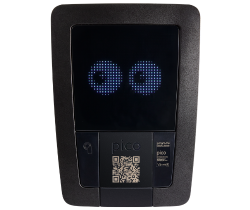
Pico is a MID-certified charging station with an integrated mobile network and WiFi interface for transmitting real-time data. The charging station synchronises the measured values automatically and encrypted to the smart-me Cloud. The station can be integrated into the eCarUp backend and offers static and dynamic load management. The data can be exported to third-party systems and processed further in the smart-me Portal or via our open interface.
Key installation notes at a glance
-
Pico has phase switching - please connect all phases according to the labelling (L1 = L1, L2 = L2, L3 = L3)
-
For outdoor use in particular, follow the assembly instructions so that you do not forget any sealing elements. IP55 is only achieved with the sealing elements. Installation and assembly instructions (German)
-
Tighten the sealing elements adequately and check that the seals are seated correctly.
Multilevel load management (50 min)
What is behind the MID certification (30 min)
Short video: Pico receives MID (2 min)
Feature overview
-
Integrated load management and load balancing with phase balancing
-
Integrated SIM card with data volume for 10 years
-
MID certification and load profile certification of the internal meter hardware thanks to the large display
-
Integrated fault protection devices 30mA AC according to IEC60947-2 and 6mA DC IEC62955
-
German calibration law certification (Art. no. 242070, 2402070/1)
-
Easy assembly (small and light), suitable for flat ribbon cable
-
Identification via RFID, app, CarID and prepared for ISO 15118 (Plug & Charge)
-
Prepared for ISO15118 powerline communication (Plug&Charge, V2H, V2G)
-
Encrypted real-time data connection to the smart-me and eCarUp Cloud
-
Easy installation with the free smart-me app.
-
Interfaces to third-party systems via API, CSV, MSCONS, IS-E and others
-
Solar-optimised control
-
Load shedding according to Paragraph 14a (Germany)
Configuring Pico
Information on assembly, MID mode, how to verify charging sessions in compliance with calibration law, status and error messages can be found in the installation manual (.pdf)
The installation is covered in detail here: Commissioning
The configuration is covered in detail here: Pico Configuration
Technical data
| Feature | Value |
|---|---|
| Maximum charging power | 22 kW at 32A three-phase 7.36 kW at 32A single-phase |
| Smart meter | Integrated electricity meter (MID, CH load profile, DE calibration law) incl. security processor |
| Phase balancing | Automatic phase balancing |
| Load management | Automatic load management across multiple stations |
| Identification | Automatic detection and identification of the car RFID / NFC reader (JEWEL, MIFARE, FELICA, ISO14443, NFC_DEP, ISO14443_B, ISO15693) |
| Communication | WLAN IEEE 802.11 b/g/n (2.4 GHz) and LTE Cat-M1 incl. SIM and data traffic for 10 years from 1nce, Modbus TCP, OCPP-J 1.6 |
| Cloud connection | Connection to smart-me and eCarUp Cloud |
| Safety | From year of manufacture 2024, SN 7002702: RCD Type-A (30mA AC) IEC 60947-2 + RDC-DD 6mA DC IEC 62955 Before year of manufacture 2024, up to SN 7002701: RDC-DD (30mA AC, 6mA DC) IEC 62955 |
| Temperature range | -25°C to +40°C |
| Mains voltage | 3x230/400V (+/- 10%) 50Hz |
| Charging socket | IEC 62196-2 Type 2 |
| Degree of protection | IP55 (indoor and outdoor) |
| Impact resistance | IK10 |
| Environmental conditions | M1, E2 |
| Load shedding | 2 potential-free inputs (4 states): Vlow: ≤ 2V AC/DC Vhigh: ≥ 12V AC/DC Vmax: 48VDC/230VAC |
| S0 output | 10'000 Imp/kWh |
| Power connection | top, bottom, rear |
| Installation type | Busbar, flat ribbon cable, star-shaped |
| Dimensions | L:300 mm W:220 mm H:112 mm |
| Weight incl. mounting plate | 3.8 kg |
| Cable cross-section | min. 2.5 mm², max. 10 mm², or 6.5 mm diameter with wire end ferrule |
| Cable diameter | 10-20 mm |
| Server location | Switzerland |
| Last change | 03.06.2026 |
Function descriptions
ISO 15118 communication standard (Plug&Charge, V2H, V2G)
What kind of standard is this?
The ISO15118 standard is a communication standard between vehicle and charging station. It describes the physical requirements and protocols as well as the supported functions of this interface.
The functions primarily include:
-
Charging authorisation for Plug & Charge
-
Charge management for charging and discharging vehicles (unidirectional charging, bidirectional charging for V2H and V2G)
What is the goal of the standard? The goal of this standard is a homogeneous integration of the vehicle and its storage into the public grid or into the home system as a storage unit. In the long term, the vehicle storage should be usable to stabilise the public grid (V2G = Vehicle to Grid) or as a home storage solution (V2H = Vehicle to Home).
Is this already a reality?
The use of this standard is still very limited. Various charging hardware and vehicle manufacturers are currently carrying out tests on this topic in order to align and further develop the communication. Plug & Charge solutions are in some cases already in operation in real life, but are not yet particularly widespread.
V2G and V2H applications are already partly supported today by DC charging stations. The offering for V2G and V2H on the AC charging station side is currently still very limited or non-existent, because the necessary equipment is not available on the vehicle side.
However, the first vehicle manufacturers have already announced vehicles that will have the technical equipment. At present, however, none of these vehicles can be purchased on the market. (As of 16.05.2025)
What does this mean for your Pico charging station?
Your Pico charging station is fully prepared for the future. A software update will be sufficient to unlock the functions on your Pico. We are currently working intensively on implementing the functionalities.
RCD / DC fault detection and load protection
The integrated safety devices check their functionality fully automatically.
-
At least every 24 hours since the last check.
-
Whenever the device is restarted.
If an error occurs during the self-checks, no power will be released and the information will be shown on the display. If an error occurs during the charging session, the power is interrupted and the error is shown on the display.
The error can only be reset mechanically by unplugging and plugging the charging cable back into the charging station.
Display
The behaviour of the display is described on the page Pico display

Pico connections and dimensions
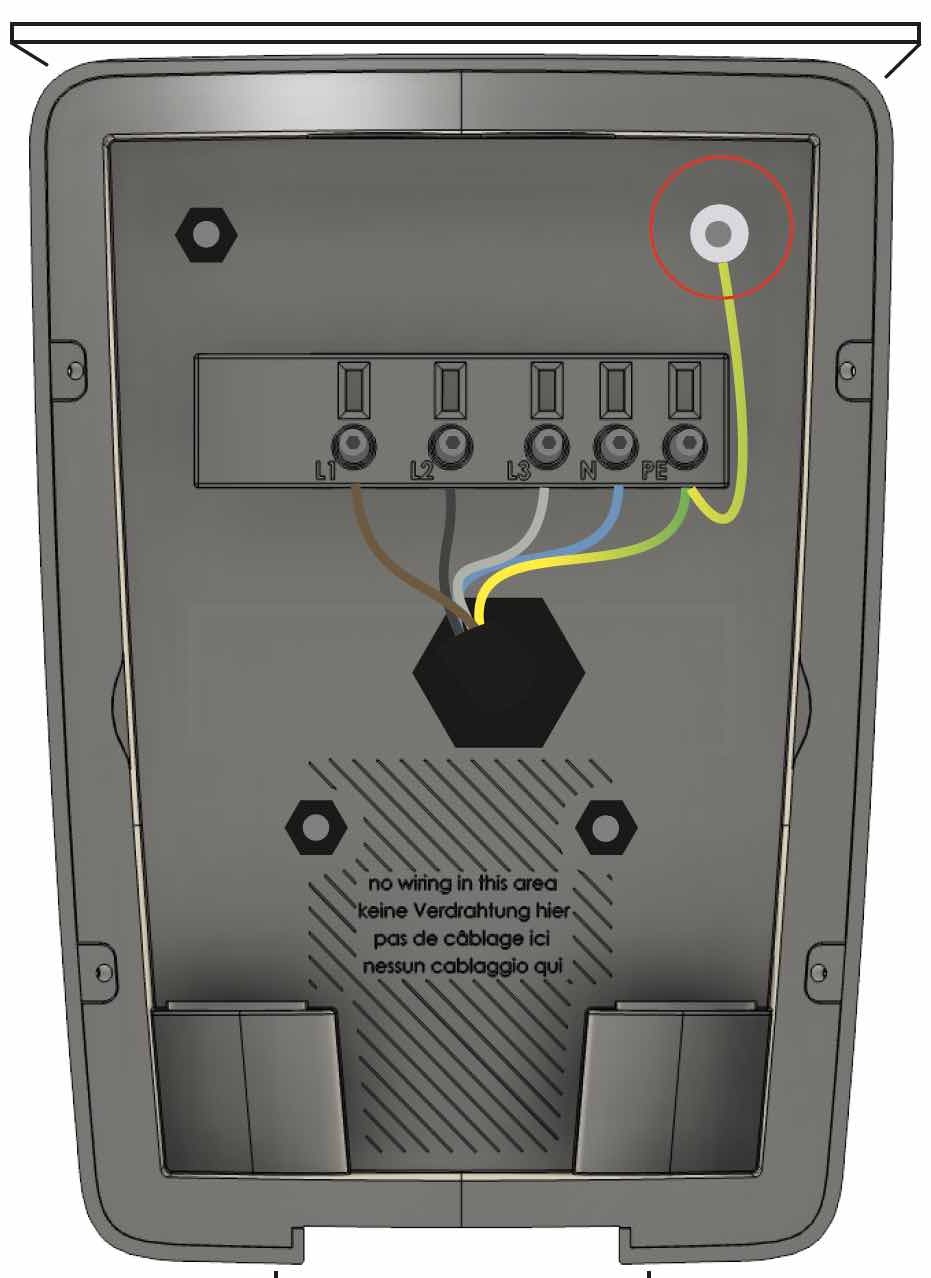
Connection diagram
L1: Phase 1
L2: Phase 2
L3: Phase 3
N: Neutral conductor
PE: Protective earth conductor
The protective earth conductor should be attached to the upper connection screw so that the stand is earthed directly together with the station.
Caution: The product can only be operated in 3-phase star connection or single-phase!
Cable routing
With Pico, the cables can be routed in and out at 5 points.
Two at the top, two at the bottom and one through the back plate.
For routing through the back plate, a hole with a diameter of 25-26mm must be drilled.
Details on stand assembly can be found in the assembly instructions in the downloads.
Load shedding (external inputs)
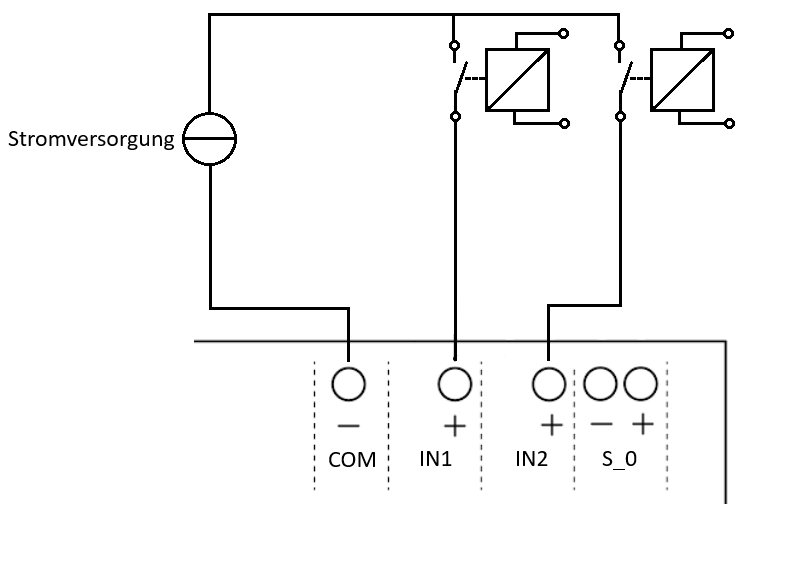
Pico load shedding
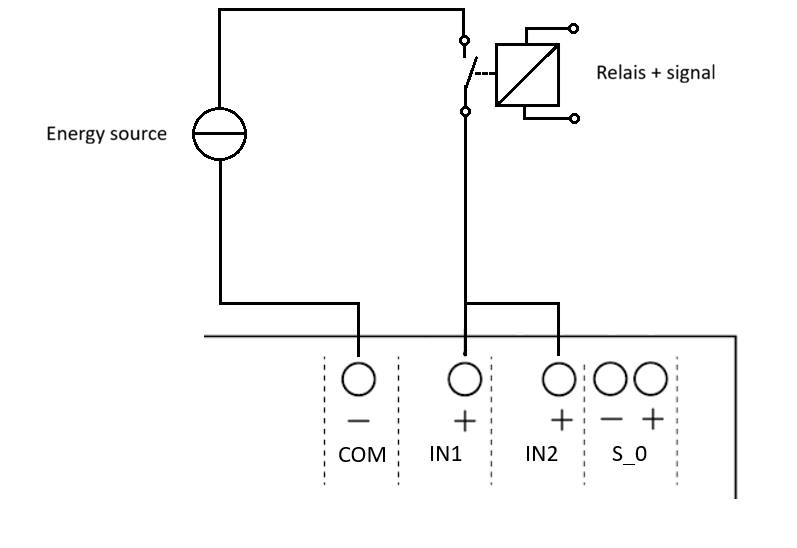
Load shedding can also be implemented with only one available signal.
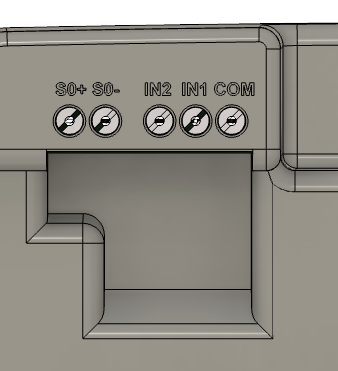
For the configuration from no charging to maximum charging power, the signal is wired to IN1 and IN2 as well as COM. For the configuration from 6A minimum power to maximum charging power, the signal only needs to be wired to IN2 and COM.
COM is the neutral conductor; IN1 and IN2 must be supplied with a voltage for the ON signal. IN1 and IN2 do not generate any voltage; it must be provided externally.
Caution: Load shedding can be wired either to all Picos or, at a minimum, to one in each load group. This function is also guaranteed without an internet connection.
Alternatively, load shedding can also be carried out via multilevel load management using meter input signals.
Dimensions
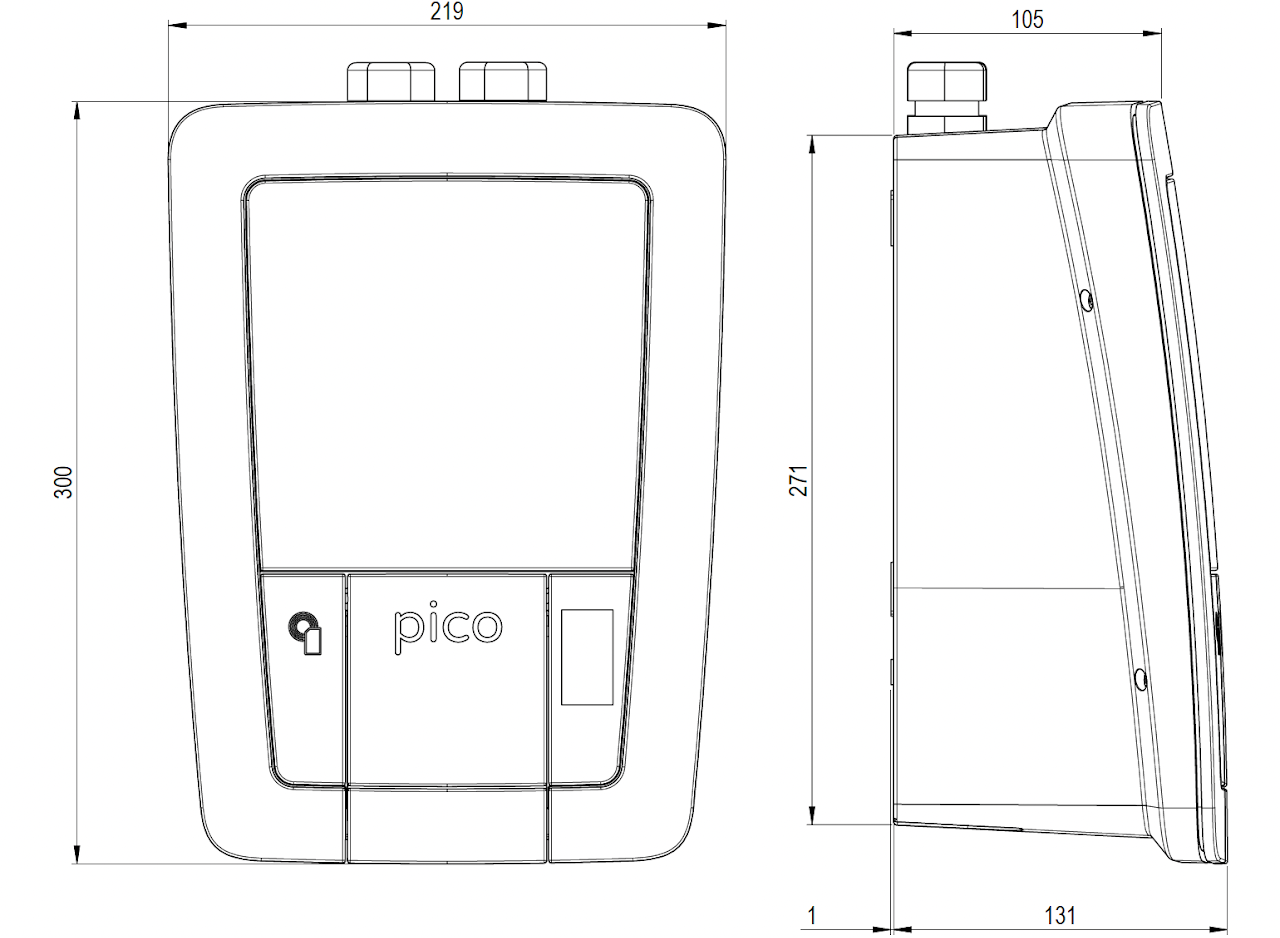
*.DXF and *.DWG data can be found in the ZIP archive in the downloads.
Shipping information
232070 and 242070 smart-me Pico charging station incl. mounting plate
Customs tariff number: 85044055
Weight with packaging: 4.6 kg
Packaging size: 400x300x200mm
Packages per Euro pallet: 72 pieces
232070/1 and 242070/1 smart-me Pico charging station without mounting plate
Customs tariff number: 85044055
Weight with packaging: 3.3 kg
Packaging size: 400x300x200mm
Packages per Euro pallet: 72 pieces
Accessories
Safety instructions
The safety instructions must be observed under all circumstances:
Installation, maintenance, repair, commissioning:
-
Read the entire manual carefully before installing and operating the product.
-
Danger to life due to high electrical voltage. Never make changes to components, software or connection cables without first disconnecting the power. For this reason, the corresponding upstream fuses must be removed and stored so that other persons cannot reinsert them unnoticed.
-
The product may only be installed, repaired or maintained by an authorised electrician. All applicable local, regional and national regulations for electrical installations must be observed.
-
Serial numbers before 7002702 require an upstream RCD Type-A in order to meet national installation standards. See Material recommendation RCD Type-A.
-
The installation must not take place near flammable or explosive media, in flood-prone areas (underground car park) or in areas where there is a risk of running water.
-
The product must be installed at a permanent location. The connections on the Pico and the back plate are designed for a limited number of plug-in cycles.
-
The product must be installed on a wall or structure with sufficient load-bearing capacity.
-
The connection terminals in the back plate are live when the circuit is closed and must under no circumstances be brought into contact directly or with any objects other than the Pico electronics.
-
Depending on the type of installation, permits may be required before installation, e.g. if the building connection capacity is increased.
-
The charging station must be registered with the grid operator.
-
The screws of the cable connections should be tightened with a torque of 3 Nm. The maximum diameter of the cable with wire end ferrule is 6.5mm.
-
The product must be operated in combination with a miniature circuit breaker. The short-circuit capacity of the miniature circuit breaker must correspond to the maximum short-circuit capacity of the connection point. For selectivity, one miniature circuit breaker may be sufficient for several charging stations. Observe the country-specific notes on our wiki. The stations can handle individual short circuits of up to 3kA without any problems.
Intended use:
-
This product is intended exclusively for charging electrically powered vehicles equipped with non-gassing batteries. The product may only be used with a charging cable according to IEC 62196. Uses other than those specified here are not permitted.
-
The device is intended for indoor and outdoor use.
Operation:
-
Never use or touch the product if it is damaged or not functioning properly. In an emergency (smoke, fire, sparks or other malfunctions), switch off the product immediately via the RCD switch and notify customer support.
-
Do not extinguish the product with water or clean it with running water.
-
Do not immerse the product in water or other liquids.
-
This product is not intended for operation by persons with limited physical, mental or sensory capabilities (including children) or by persons without knowledge of the product.
-
Make sure that children do not play with the product.
-
Never touch the contacts of the Type 2 charging socket and do not insert any foreign objects into the product.
-
Never use the charging cable if it is damaged or if the connectors are wet or dirty.
-
Do not use extension cables or non-approved adapters in combination with the product.
-
Never kink the charging cable, drive over it or expose it to high heat.
-
Only pull the charging cable out of the charging holder by the plug.
-
Do not lay the charging cable in the paths of other road users and always position it so that there is no risk of tripping.
-
Protect the charging cable from weather influences such as direct sunlight, wind, rain, humidity and wetness, and never connect it with damp or wet hands.
-
Do not use the product near strong electromagnetic fields or in the immediate vicinity of mobile phones.
FAQ
Why does the Pico always reserve 6A in the load group even though the car is no longer charging?
The IEC 61851 standard stipulates that every car must always have at least 6 A available. The standard provides for this so that a parking heater can be supplied from the grid, or so that the battery is not discharged if someone is away for several weeks.
Does Pico require an upstream RCD Type-A per charging station?
Pico charging stations with serial numbers before 7002701 require an upstream Type-A RCD 40A 30mA to meet national standards. The function is present in these devices but is not compliant. From serial number 7002702 or BY2024, the Pico no longer requires an upstream RCD; it is now integrated and compliant according to 60947-2.
Which material is suitable for this is described under Material recommendation RCD Type-A.
Does the Pico charging station support ISO15118 for Plug & Charge and V2G / V2H?
The Pico charging stations have all the technical equipment to support the ISO15118 and ISO15118-20 standard in the long term. Enabling the Pico to support the functions depends exclusively on software and does not require any hardware change or modification.
Bidirectional charging V2H and V2G with the Pico: Enabling the Pico charging station for bidirectional charging under ISO15118-20 depends exclusively on the release and availability of the functions and equipment on the part of the vehicle and the vehicle manufacturer. The charging hardware of the Pico charging station does not represent a limitation in this respect.
The first vehicles capable of this that can actually be purchased are expected in the coming years.
We are continuously working on developing these functions in our Pico charging station so that we are ready for that moment.
Can I reset the meter reading to zero?
No, since our meters are used for billing, it is not possible to reset them.
Installation manual, downloads and declaration of conformity
Data sheet
Technical documents
Installation and assembly instructions (English)