Certifications
This page applies to Germany. There is a separate page for Switzerland and Liechtenstein. The product standards and the MID apply in both countries and are therefore listed on both pages.
General product standards and EU regulations
RED - Radio Equipment Directive and EN 18031
The Radio Equipment Directive must be met by all devices that have interfaces with wireless connections and are intended to be offered in Switzerland or the EU. It covers, for example, compliance with signal strengths, interference emission and interference immunity of Wi-Fi, 4G and Bluetooth modules. It also covers functionalities and the security requirements for these modules and products.
The RED (EU) 2022/30 is currently being extended by Articles 3.3 d, 3.3 e and 3.3 f. These address the aspect of cybersecurity for the network and protection against data theft / data manipulation and hacking.
Since 01.08.2025, the standard EN 18031-1, -2, -3 can be used to meet these supplementary RED articles.
smart-me AG develops all of its products in accordance with EN 18031.
This includes, for example, the following points:
-
Encrypted, authenticated communication from the device all the way to the cloud.
-
Secured and separated areas of the firmware for measurement, communication and display.
-
Immutability of the firmware for the measuring hardware.
-
No unnecessary communication channels enabled by default.
-
Use of advanced cryptographic chipsets for generating and storing cryptographic keys.
-
Resilience against external attacks such as DDoS attacks.
Product standards in general
Product standards generally describe the framework to be met with regard to EMC, safety and functionality of a product. For almost all products there is a defined standard that can be used during development. However, the standards cannot always be applied precisely to a given product. In some cases, several product standards must be met at the same time.
The product standards applied are listed on the product's certificate of conformity.
Measuring Instruments Directive (MID) - Certification
In the conformity assessment procedure, a designated body checks whether the measuring instrument or the manufacture of the measuring instrument meets the legal requirements. The conformity assessment is carried out by the designated body on behalf of the manufacturer of the measuring instrument. The manufacturer then issues the declaration of conformity for the measuring instrument with regard to compliance with a legal standard.
If the measuring instrument is subject to the Measuring Instruments Directive 2004/22/EC (electricity, heat, water, cooling or gas meters), the conformity assessment body must additionally be notified by the EU Commission.
Such measuring instruments can be recognized by the "CE" or "CH" marking in combination with the metrology marking "M".
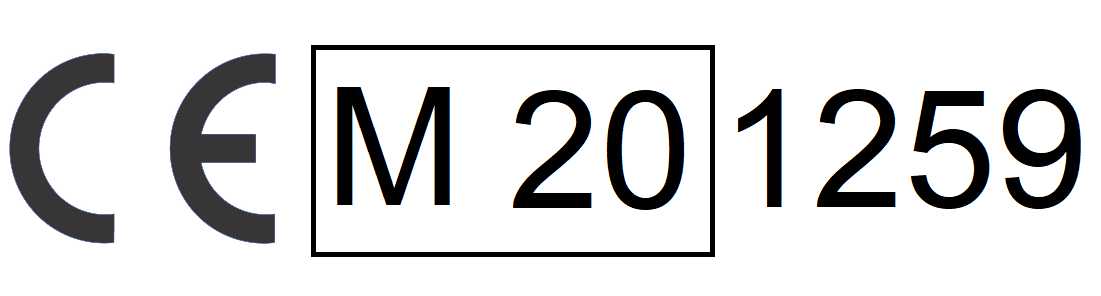
Example: CE M 20 (year of verification) 1259 (verification body)
Certifications for charging stations in Germany
Charge points in rental properties:
For charging station hardware used in a rental property, Germany generally requires the same as for standard meter hardware:
- MID certification in order to be allowed to bill the recorded energy.
Charge points in public areas with different users:
- In Germany, public charge points must comply with the calibration law (Eichrecht). The basis for Eichrecht compliance is that the meter hardware in the charging station has MID certification.
Note: The labels on the right are mandatory symbols that must be visible on the hardware at all times in order to have MID, load profile or Eichrecht compliance.
Mandatory labels on the charging hardware:
MID certification:

Eichrecht:


Calibration law (Eichrecht)
The Eichrecht is a German law that regulates the accuracy and transparency of measurements in Germany. When charging electric vehicles, this regulation ensures that the measurements at the charging stations are accurate and transparent in order to protect consumers.
Under the Eichrecht, EV charging stations must be equipped with an electricity meter that is certified and calibrated (MID). The electricity meter measures the energy consumed and determines the amount charged to the EV driver.
The Eichrecht regulations also govern other aspects of billing. Charging stations must display prices clearly and provide customers with a receipt stating the amount of energy consumed, the price charged and other relevant details.
It must also be possible to cross-check the correctness of the charging sessions using independent transparency software.
The calibration law also governs data security and energy losses during charging sessions caused by cabling or other means.
Tenant electricity
The billing of tenant electricity is subject to the same meter hardware requirements as above: an MID-certified measuring device is the basis. How to set up and bill tenant electricity in smart-me is described under Energy Billing (Germany).