Virtual ZEV (vZEV)
The virtual association for own consumption - vZEV
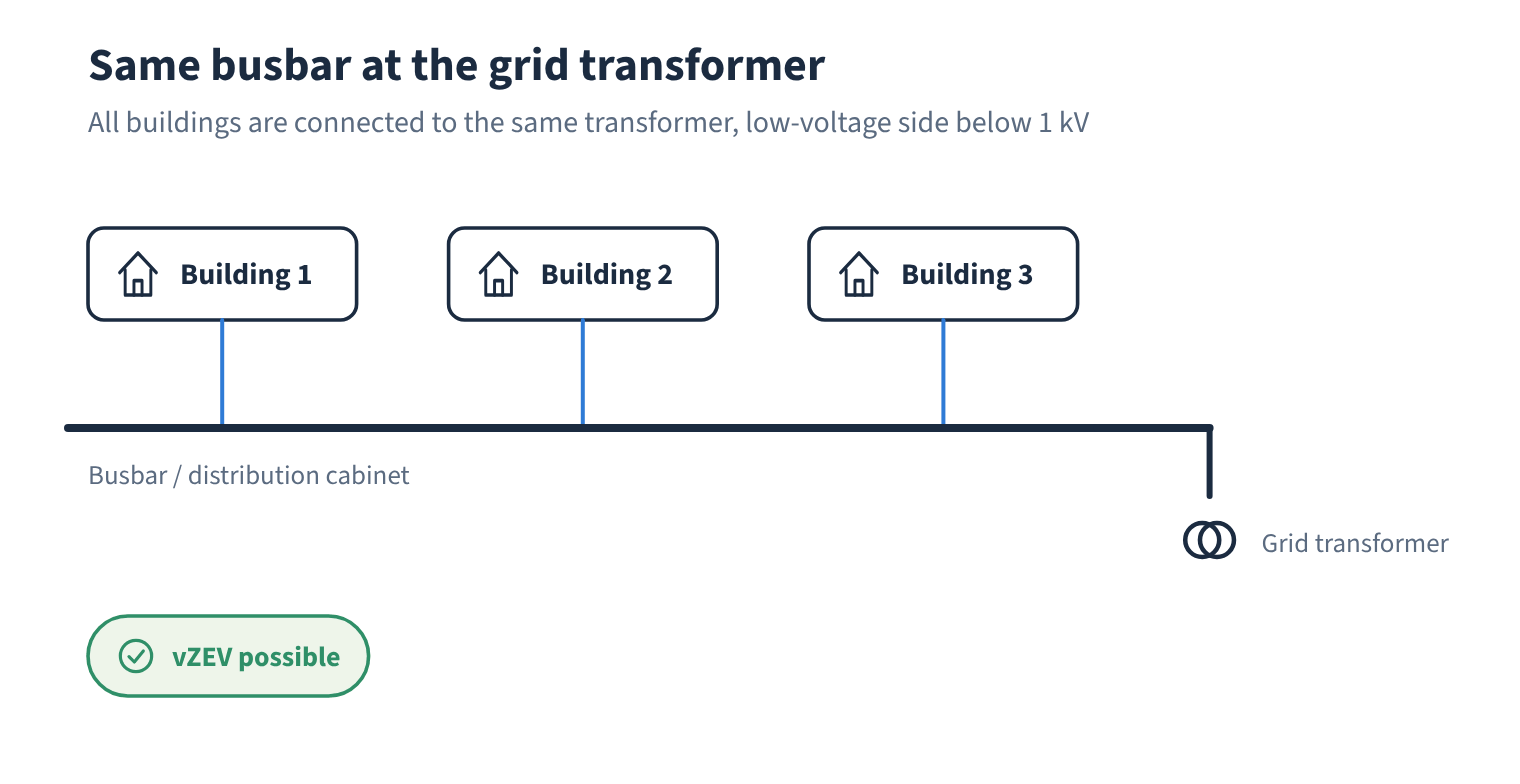
A vZEV is a ZEV (association for own consumption) that includes the grid. Unlike a conventional ZEV, where all buildings must share one and the same grid connection, a vZEV makes it possible to combine several grid connections on one and the same low-voltage transformer (< 1kV).
In addition to this basic requirement, further points must be clarified to determine whether, and with whom in the neighbourhood, a vZEV is possible.
These include:
-
the actual grid topology
-
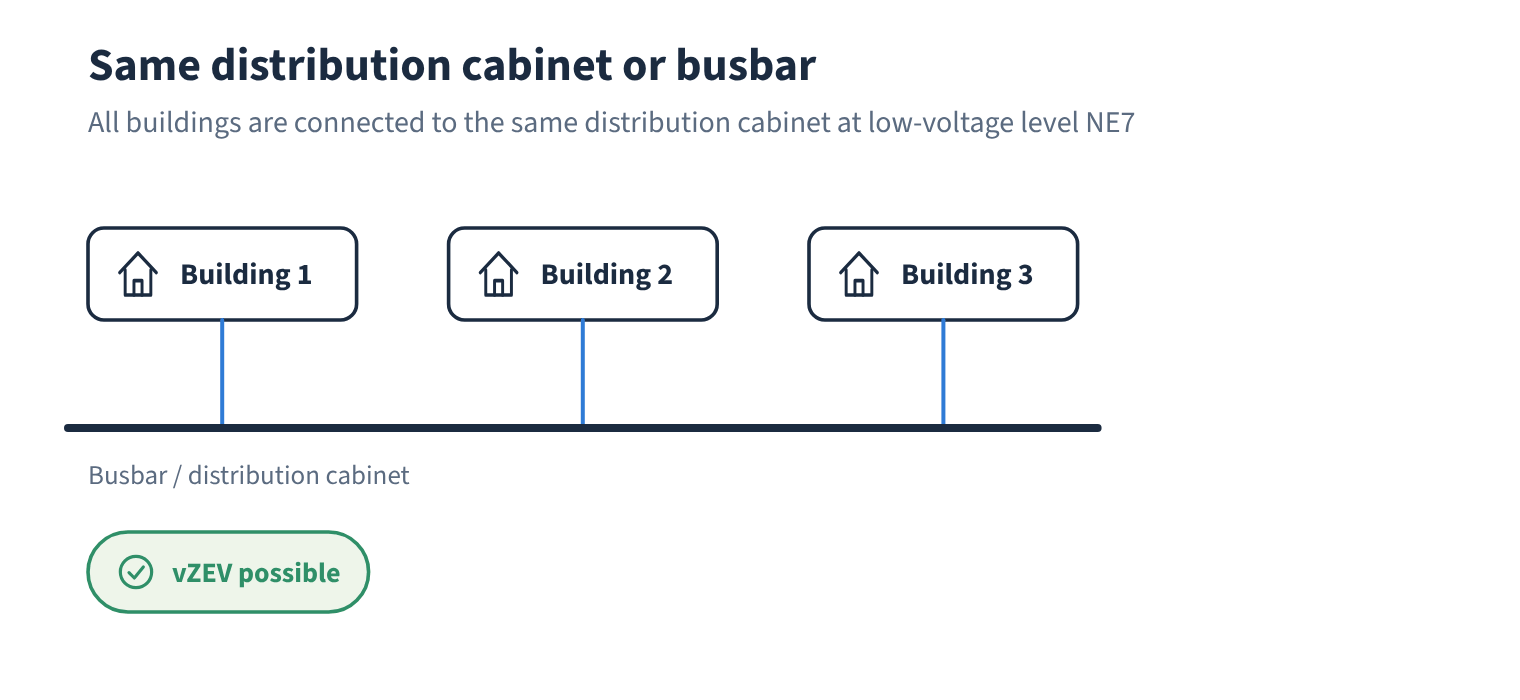
connection types (sleeve-joint networks or distribution cabinets)
0:00 Introduction webinar vZEV
03:47 Usable metering infrastructure for vZEV
16:00 Self-consumption models
28:33 smart-me vZEV
30:19 Live demo
35:18 FAQ
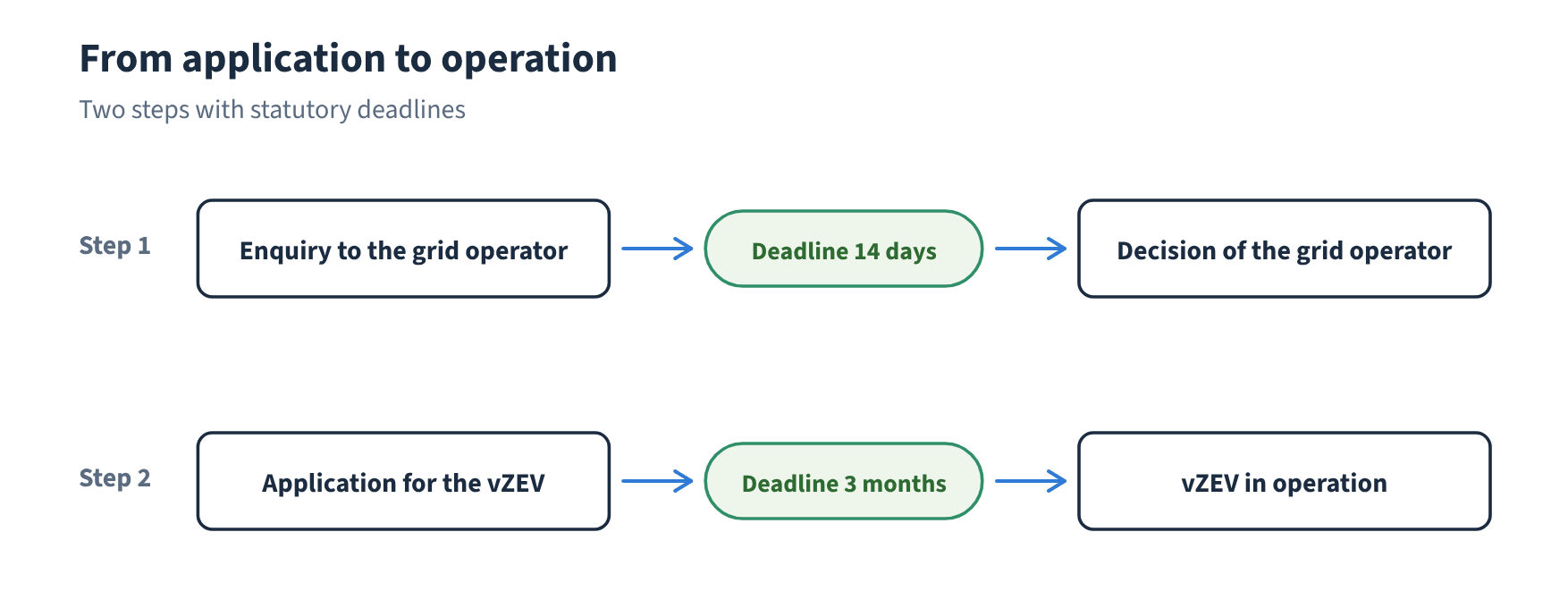
Step 1: Initial vZEV assessment
This initial assessment of these topics is requested directly from the distribution system operator (DSO).
Afterwards it is clear whether a vZEV is possible and, if so, with which participants.
The DSO must provide this information, with a positive or negative response and a justification, within 14 days at the latest.
Step 2: Determine participants and apply for the vZEV
In a second step, interest must be assessed. You notify the potential participants of the opportunity to take part in the vZEV. Both the information provided and the positive responses should be recorded in writing, with signatures confirming participation. These will be needed later for the data transfer authorisation, as well as an annex to contracts and other documents.
At this point, an official vZEV registration listing all interested parties must be submitted to the DSO. Within 3 months, further points regarding the vZEV are checked and completed.
-
The production capacity must be at least 10% of the consumption capacity.
-
Are all participants located behind the same connection point at low-voltage level?
-
Are smart meters already installed at all locations or not? (If not, they must be retrofitted)
-
Is additional hardware available for local reading of the metering points and/or is there an application for SDTA transmission via Swisseldex?
Once all the above points have been fulfilled and around 3 months have passed, the vZEV can start operating.
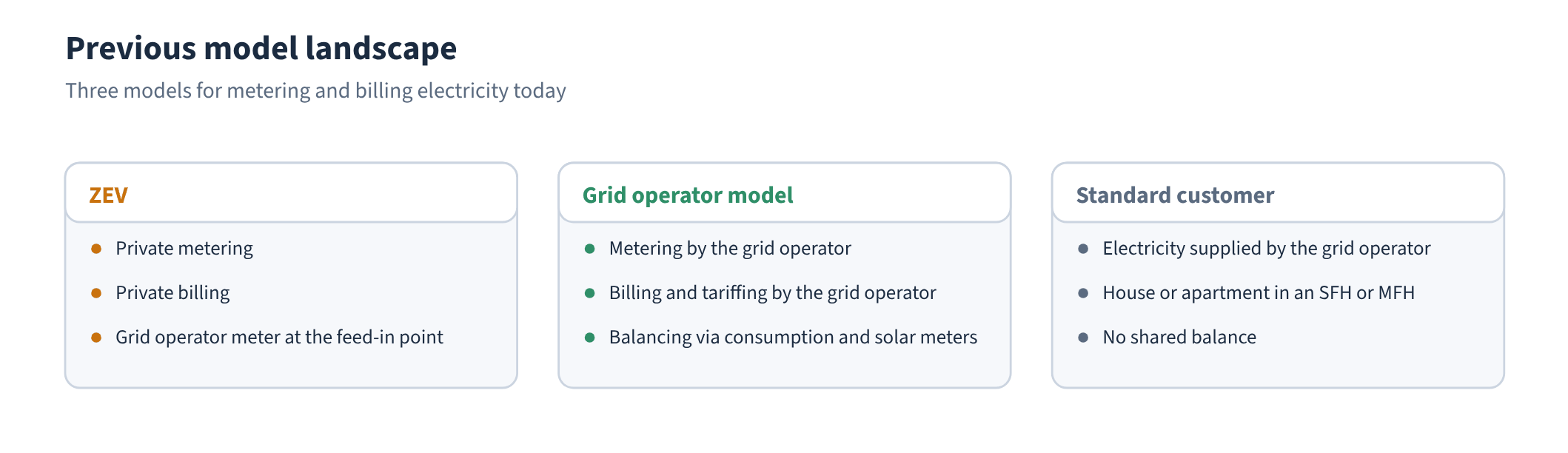
Previous model landscape
vZEV models
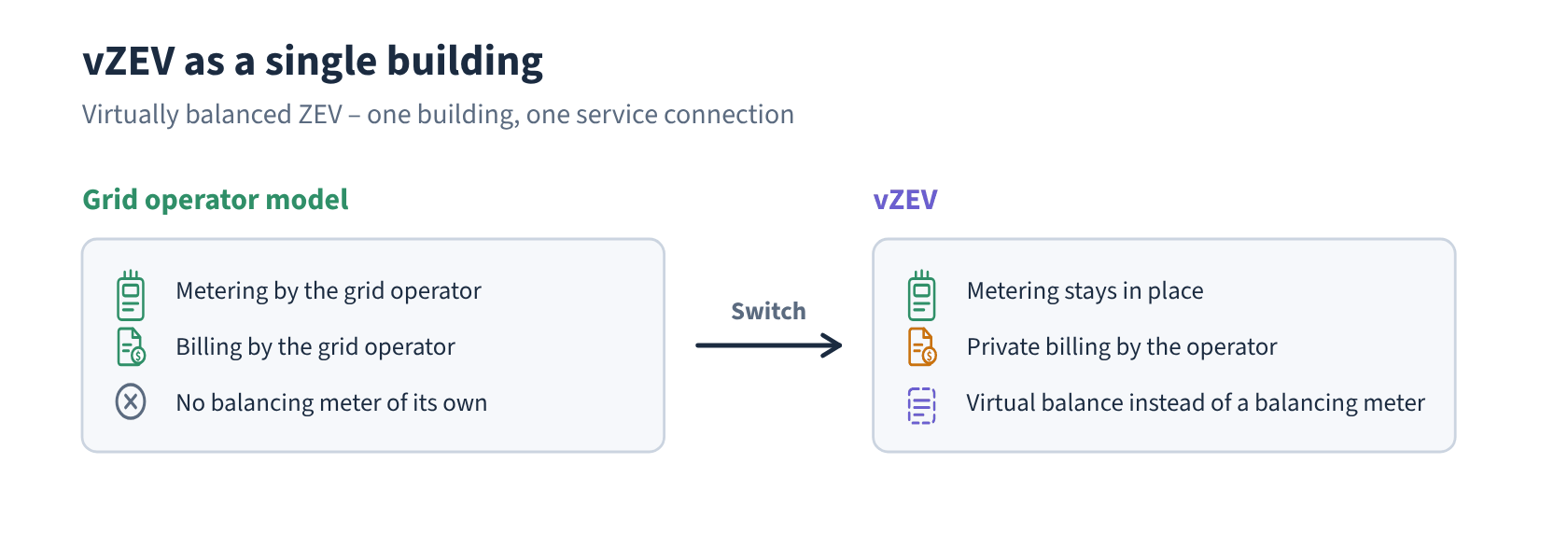
Single-building vZEV (virtually balanced ZEV)
A building shares a common house connection.
Switching from the DSO model to a vZEV is easy.
In principle, the previous DSO model is simply managed and billed privately as a vZEV and is thus independent of the DSO's services.
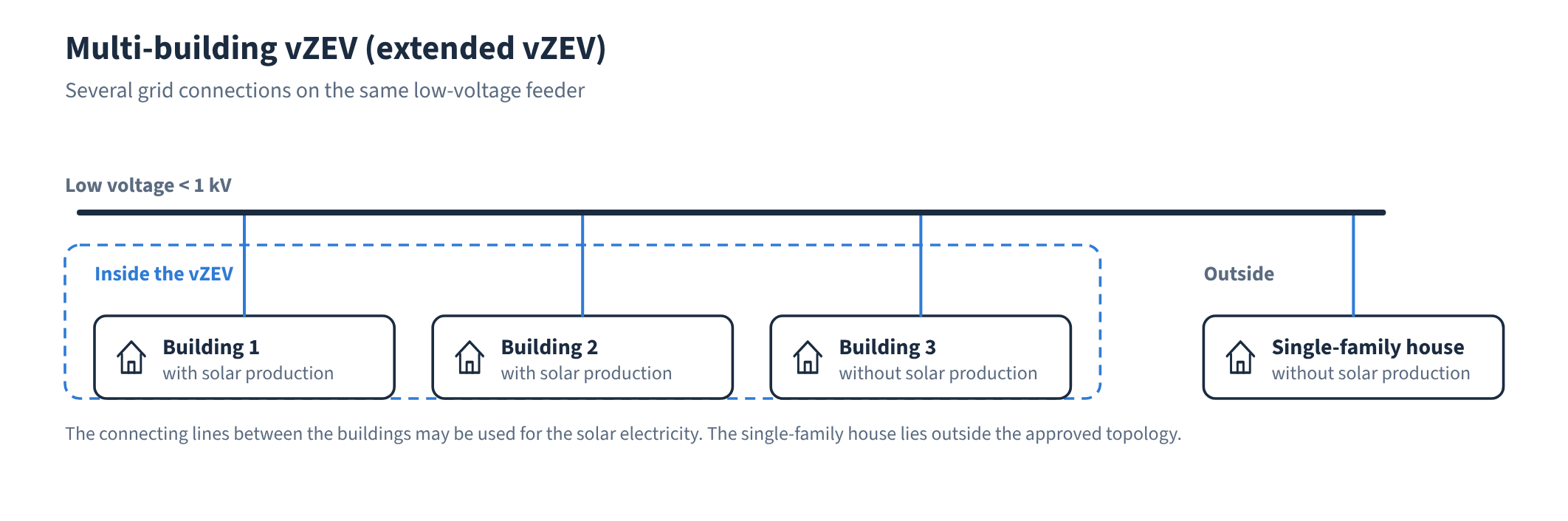
Multi-building vZEV (extended vZEV)
Several ZEVs or buildings with their own grid connection share the same low-voltage connection (<1kV)
They may now use the connecting lines between the buildings to transmit solar power.
This means that the energy produced in the buildings on the left is also made available to the apartment buildings on the right.
But not to the single-family house, as it is located outside the approved topology of a vZEV.
The topology requirements for eligible participation in the vZEV are defined in more detail below.
Grid topologies for setting up an extended vZEV
Possible members of a vZEV and metering technology
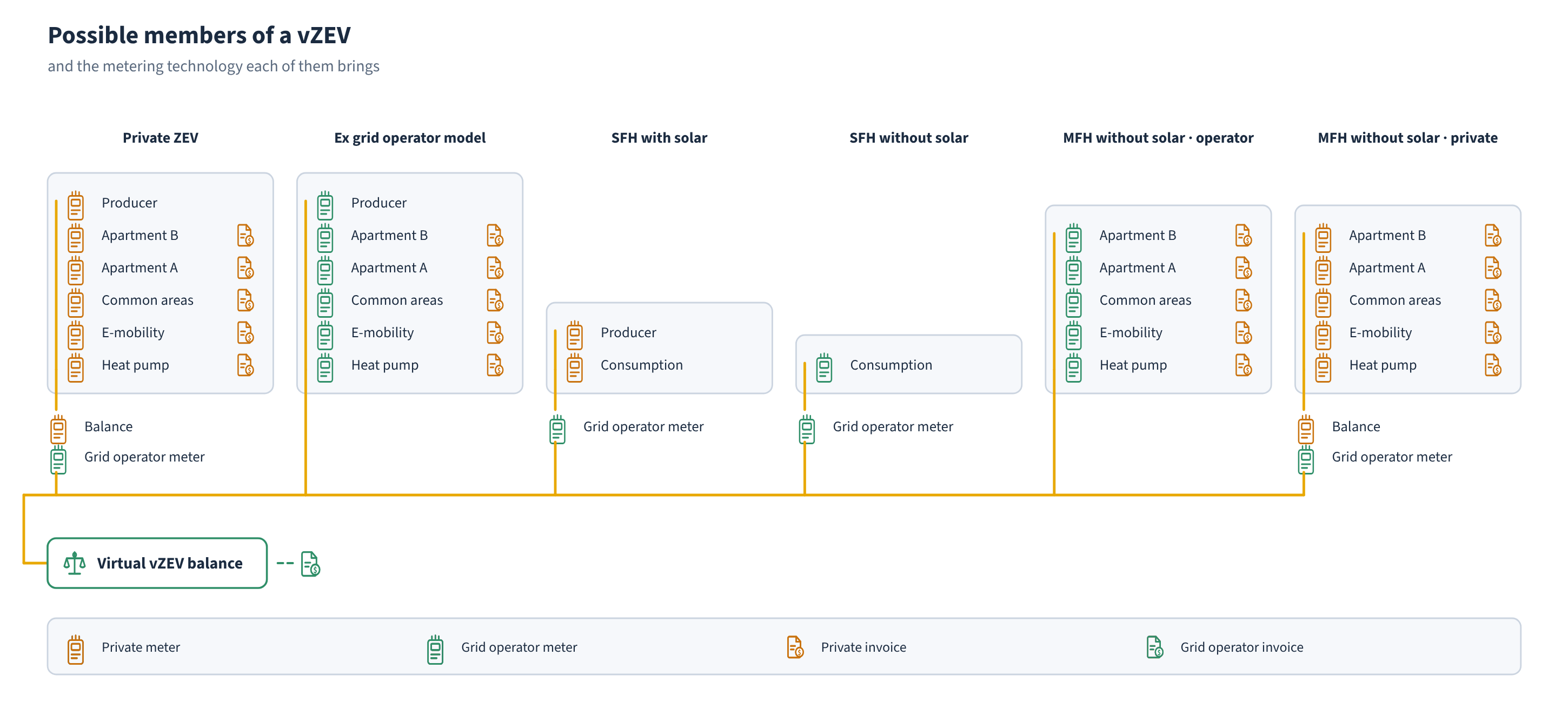
In a vZEV, different infrastructures from the grid operator and from the private sector can come together. The metering of the various buildings can be provided in different ways and is combined in the vZEV into a uniform tariff model.
-
Former practice model (DSO)
-
ZEV with private metering (balancing meter from the DSO)
-
Single-family houses with solar production
-
Individual apartments and houses without solar production with private metering or DSO metering.
Meter infrastructure for the vZEV tariff model
The tariff structure of a vZEV is based on equal rights for all participants. All participants have an equal claim to the solar power currently being produced.
For the tariffs of the various models to work together, selected meter units are required, which are stored as a reference in our tariff.
The following figure shows all relevant metering points required for correct balancing and tariff calculation per infrastructure.
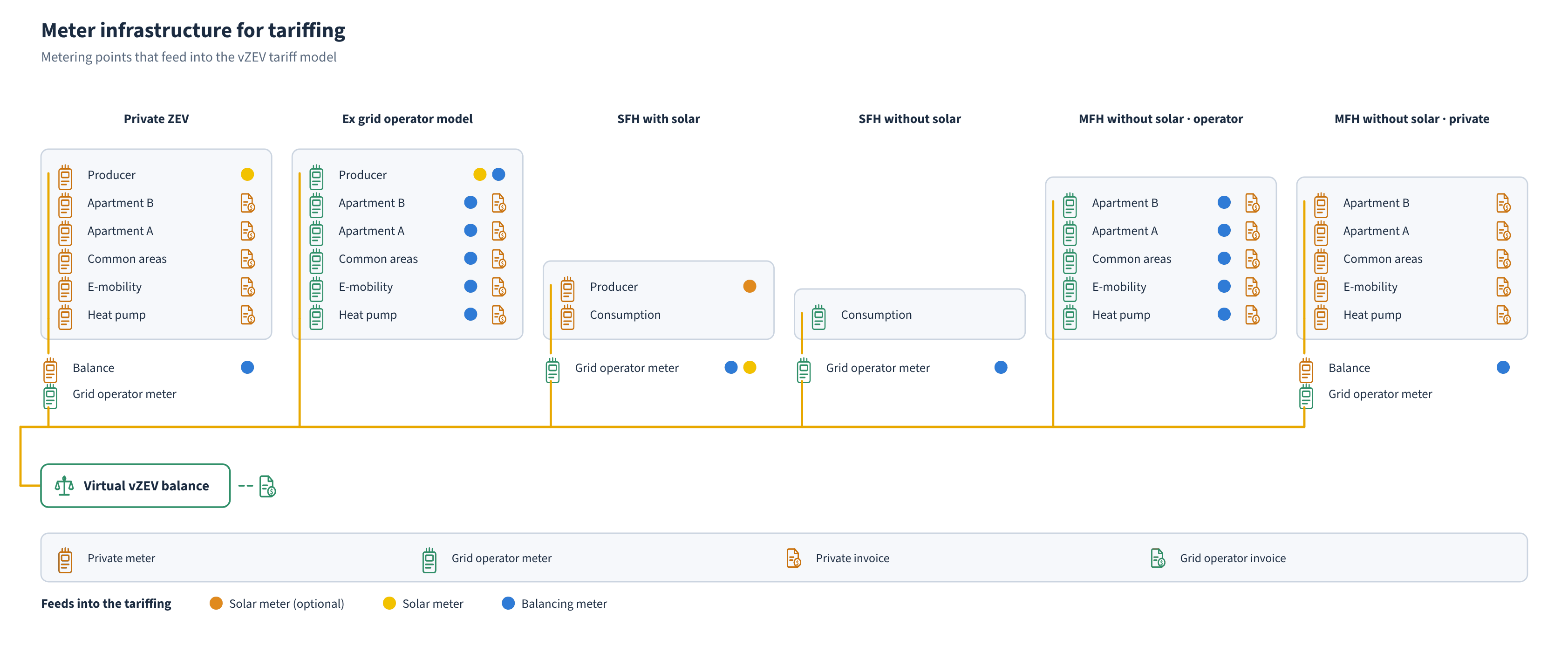
Ex-practice model (privatised ex-DSO model to vZEV)
In this model, there is no metering point serving as a balancing meter, neither from the energy supplier nor private. This ZEV is therefore balanced virtually. This requires metering of all producers and all consumers. The model works as a single building, but also as part of an extended vZEV.
Private ZEV (with balancing meter)
In this model, there is at least one metering point of the energy supplier at the main ZEV connection point. The data from this metering point can be imported into smart-me either via private sub-metering or via the energy supplier's data hub.
Private sub-metering enables efficient real-time control of the ZEV, which is only possible to a limited extent with the energy supplier's meter.
More about the metering concept of private ZEVs
House with solar production (single-family house)
In this model, there is at least one metering point of the energy supplier at the main connection point and in some cases also a production meter. Tariff calculation for a terraced house is possible without a solar production meter. Ideally, however, the solar production of the terraced house is also metered, either by the DSO or privately. This data can be collected by metering with a smart-me Telstar as private metering or as a data hub import via Swisseldex.
House or apartment without solar production (single-family house)
In this model, there is at least one metering point of the energy supplier at the house connection. The data of these consumers can be collected as a data hub import via Swisseldex.
An apartment building without a solar system but with private metering follows the metering infrastructure of a ZEV without production.
Details on configuring vZEV tariffs
Plan your project now with our configurator
Based on your input, the Projektkonfigurator creates a bill of materials of all smart-me products, the number of metering points and a visual diagram for review.
Ideal for planners and electricians.
Metering data import for energy supplier metering points
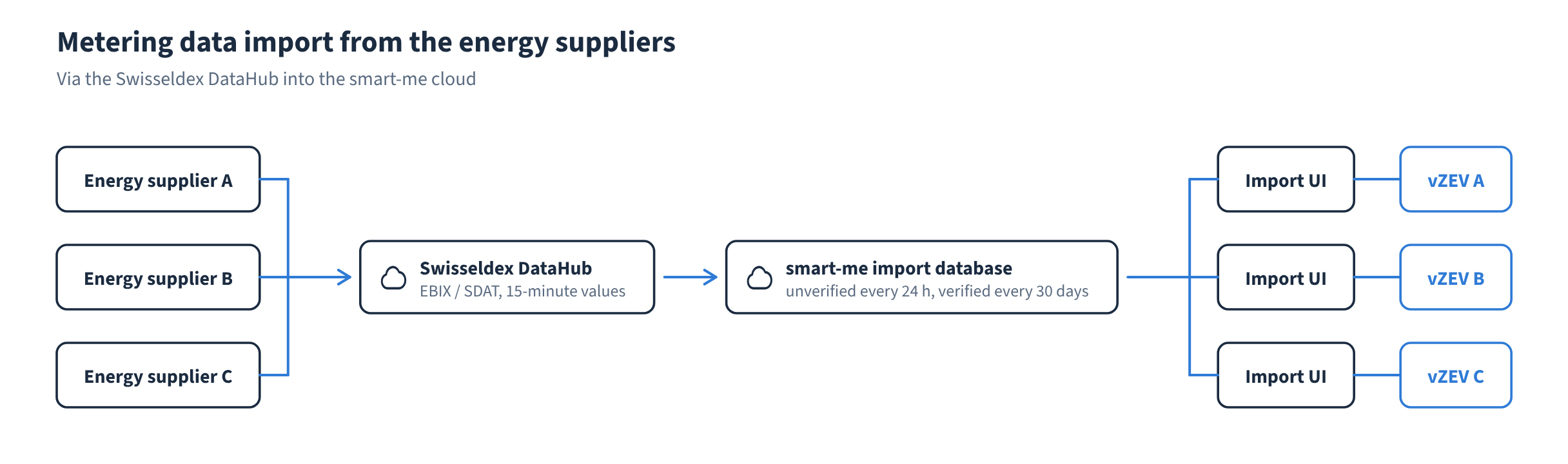
The metering data of the relevant metering points can be imported via the Swisseldex data hub. smart-me is listed as a recipient of this data at Swisseldex.
On request and after authorisation, the energy suppliers send the data via Swisseldex to the smart-me import data hub. The data can then be managed, visualised and billed in the respective smart-me account.
Properties of the energy suppliers' data:
-
EBIX, SDAT data format
-
15-minute resolution
-
Provided approx. every 24h, unverified
-
Provided approx. every 30 days, verified
You can find detailed instructions for the data import here: Details on the Swisseldex import
FAQ
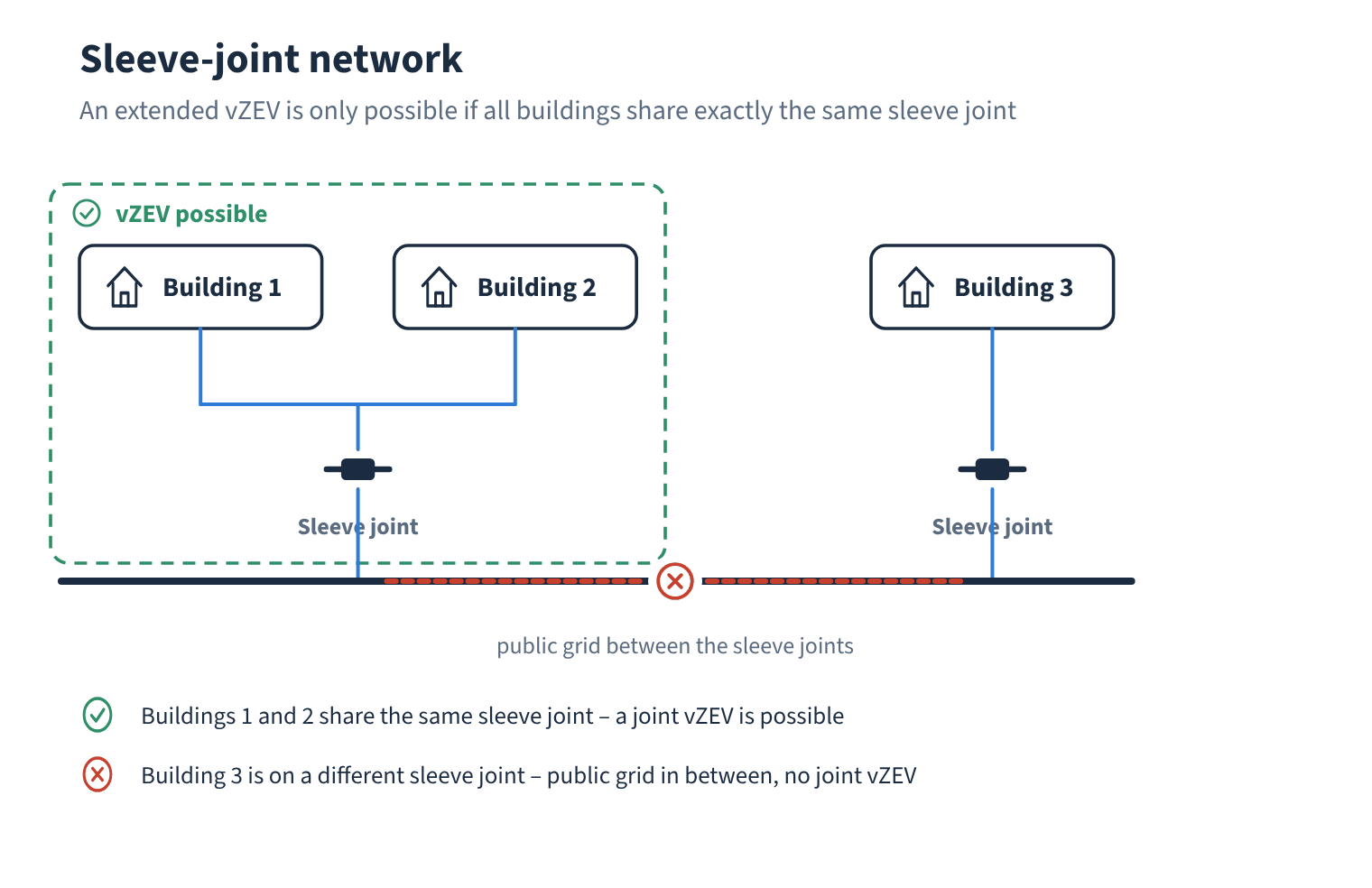
Can a vZEV be set up in a sleeve-joint network?
Yes, it is possible, but the requirements for this are only very rarely met.
For a vZEV to be set up in a sleeve-joint network, all buildings must share exactly the same sleeve joint. Otherwise, the public grid between one sleeve joint and the next is included, which no longer complies with vZEV regulations.
Can a building without a solar system join a vZEV and replace the DSO meters with private meters?
Yes, for the in-house production and consumption metering. Within the established vZEV, the vZEV operator is independently responsible for metering and billing. This also implies that the vZEV operator can use the metering equipment of their choice for the entire vZEV.
Of course, the distribution system operator also needs its own metering points for counter-metering and balancing of the vZEV. It must install these accordingly.
If an apartment building without a solar system now wants to join the vZEV, a private meter can be installed for each billing unit. The distribution system operator must then, however, install a metering point at the house connection accordingly.
Is it possible to nest several ZEVs within one vZEV?
Yes and no.
It is possible to form a vZEV from two existing ZEVs on the same transformer connection. However, it is not possible for the two ZEVs to continue to exist individually in legal terms. Legally, these two ZEVs become a single (v)ZEV.
The two ZEVs are therefore legally dissolved and replaced by one (v)ZEV.
Can the internal tariff structure and the electricity price of the ZEV or vZEV be chosen freely?
Yes and no.
It is regulated in exactly the same way as for a ZEV.
The tariff structure within a ZEV or a vZEV may be determined privately and may differ from the distribution system operator's offering. However, the legal principles of the ZEV regarding pricing continue to apply.
Example: If grid electricity is charged as a single tariff with a power tariff, it may also be decided within the ZEV or vZEV to offer only a single tariff or a dual tariff. However, it must be ensured that, regardless of the chosen tariff structure, no more money is collected than the grid electricity actually cost.
The internal solar power must also follow the rules and, depending on the rule applied, may not cost more than 80% up to a maximum of 100% of the equivalent grid electricity.