Measurement concept producers behind houses
Here we explain which measures must be taken to map the metering concept for multiple producers behind different houses.
Prerequisite
You need a smart-me Professional subscription
Important notes
smart-me does not recommend this metering concept for the following reasons:
-
There is currently no fully automated solution in the smart-me system to map this metering concept.
- Note: smart-me third-party systems, such as egonline, offer solutions that are compatible with smart-me meters. Please contact the respective providers directly for more information.
-
You should expect manual effort of approx. 30 minutes per billing unit and billing period.
-
Due to the complexity of the installation, this can lead to many queries. smart-me reserves the right to charge for the effort involved in support requests.
-
The number of kWh sold between parties within the ZEV (association for own consumption) is determined as an average over the billing period based on the surplus of the individual parties. The same applies to the return transfer to the energy supplier.
-
The self-consumption of each house that also has a photovoltaic system cannot be determined.
-
The graphics provided by smart-me are not compatible with this metering concept.
smart-me reserves the right to list further restrictions. Currently, only a few buildings are equipped with this metering concept. For this reason, smart-me is not focusing on the development of these properties. They may become simpler in the future, but we are not prioritising this metering concept in our development.
Metering concept
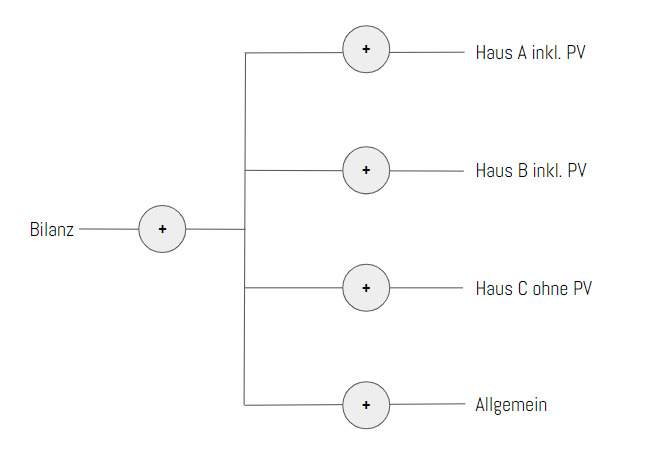
The balance, the houses and, if present, the common areas are measured.
Measuring the PV is optional and offers no advantage for billing.
Configuration
The information below assumes that you are familiar with the configuration of a smart-me Billing with the standard metering concept.
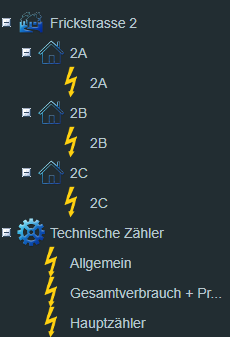
Virtual meters
Sum of all meters that are relevant for billing.
Name: Total consumption + production (Gesamtverbrauch + Produktion)

Virtual tariffs
Billing-configuration according to the standard metering concept
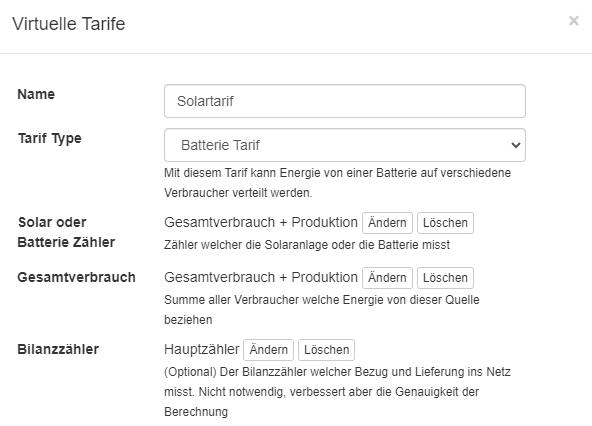
Deviation for the virtual tariff:
-
Tariff type (Tarif Typ): Battery tariff (Batterie Tarif)
-
Solar or battery meter (Solar oder Batterie Zähler): Total consumption + production (Gesamtverbrauch + Produktion)
-
Total consumption (Gesamtverbrauch): Total consumption + production (Gesamtverbrauch + Produktion)
-
Balance meter (Bilanzzähler): Main meter (Hauptzähler)
Billing
The information below assumes that you are familiar with billing in a smart-me Billing with the standard metering concept.
Fill in the Excel file
Purpose of the Excel file
- Determines the amount that can be credited to each party.
Required information
-
Bill from the local energy supplier
-
Report values from smart-me
-
PDF invoices (Billing) from smart-me.
Calculation logic
-
The surplus per house is determined (cells B35 to B43)
-
The share of PV electricity per house is determined (cells C35 to C43)
-
Distribution proportional to the surplus, averaged over the entire billing period

Add an "Other" item (Sonstiges Position)
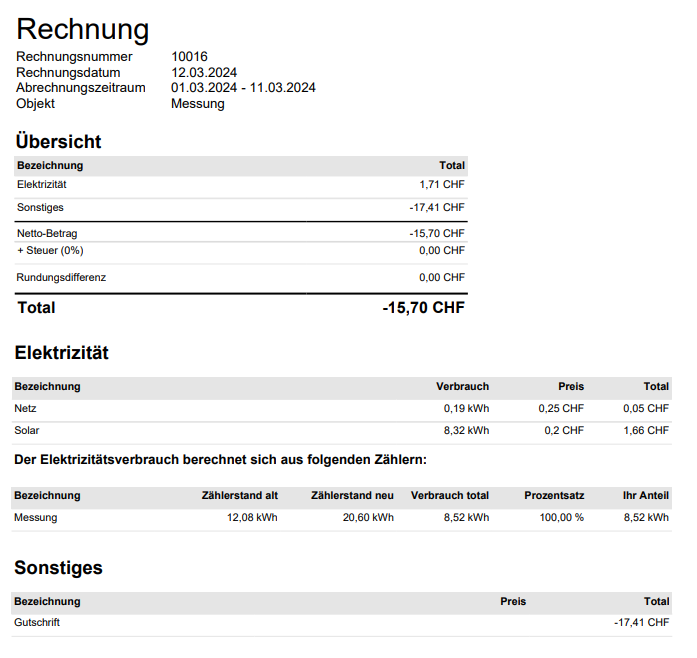
Values according to the Excel credit can be entered as a negative amount for each billing unit.
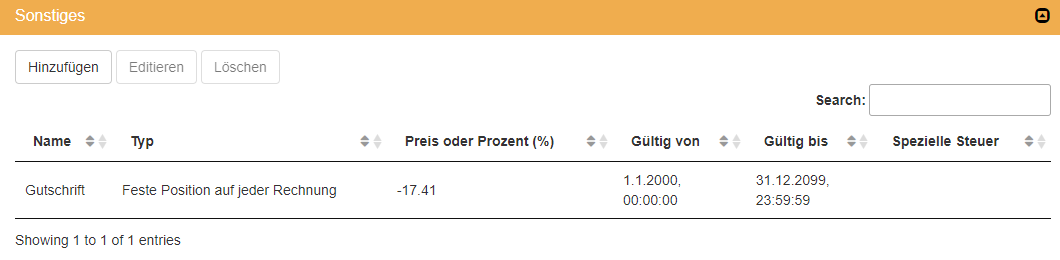
Regenerate the invoice
In smart-me Billing