Prepare Billing
Billing a ZEV
Billing electricity with smart-me energy cost billing
This type of billing supports a single tariff, dual tariffs or multiple tariffs with solar tariffs.
To bill the electricity part of the ZEV (association for own consumption), you need:
-
Professional status of the account and smart-me Billing.
-
The electricity prices and tariffs from the utility.
-
Not required: an external tariff signal connected to all meters
Billing heat and water with the VEWA function (VEWA-compliant)
To generate all energy costs in a VEWA-compliant heating and ancillary costs statement, you need:
-
Professional status of the account and smart-me Billing with VEWA function
-
The electricity prices and tariffs from the utility
-
An overview of the accrued costs for the energies to be billed
-
VEWA guideline
-
Optional: property management software for DTA-VHKA exports
-
Optional: an initial energy cost statement from a heating and ancillary costs service provider, or the necessary information from your plumbing and heating planner.
Billing e-mobility in a ZEV
| Feature | Private station with Pico | Semi-public station | Public charging station |
|---|---|---|---|
| Who can charge | only the tenant of the apartment | the tenants of the property | all eCarUp users |
| Billing | automatically together with the apartment electricity, according to the tariff model (peak tariff, off-peak tariff, solar) | Option A: The tenants charge at a price of 0 CHF. The electricity costs are charged to the property manager and passed on to the tenants via the report function (tariffs entered manually). Option B: limited, with a fixed tariff and credit card billing | The electricity costs are charged to the property manager; recharging is handled via a fixed tariff and credit card billing |
| Publicly available | no | no | yes, made publicly available via eCarUp |
| Station | Pico | Pico or OCPP station | Pico or OCPP station |
VEWA and ZEV guideline
Self-consumption guideline from SwissEnergy (general information, legal forms, costs): https://www.energieschweiz.ch/gebaeude/eigenverbrauch/
VEWA model for consumption-based energy and water cost billing: https://www.energieschweiz.ch/haushalt/warmwasser/
How tariffs and remuneration to investors work
How a tariff is identified and distributed among consumers
The identification of a tariff depends primarily on its assigned measuring devices and an optional time-dependent component (IF/THEN action).
-
Grid tariffs are treated as residual electricity quantities. This means they always apply to the electricity that could not be assigned to other tariffs by measurements.
-
Solar and battery tariffs consider the consumption and deliveries of relevant metering points, such as the PV meter and total consumption or the balance metering, plus an optional time component.
Determining the electricity mix shares per 15 minutes
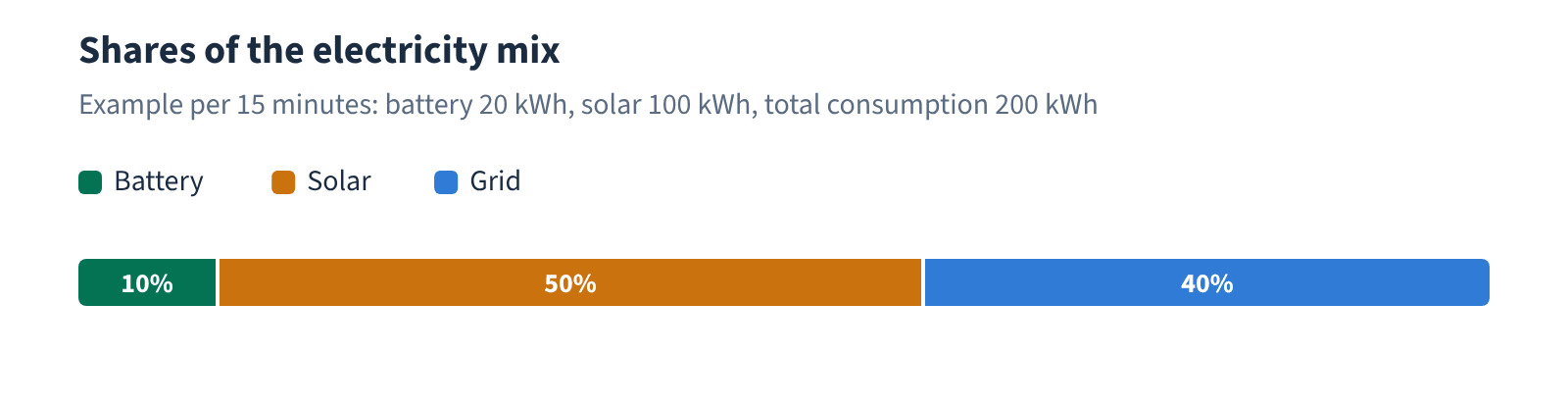
The electricity mix is always determined for 15 minutes and then applied equally to all consumers.
Example:
-
Battery delivers 20 kWh
-
Solar system delivers 100 kWh
-
Consumption in the entire property is 200 kWh
In this case, the percentage share of each supplier in the total consumption is calculated using the following formula:
% share of the electricity mix = supplier delivery / total consumption of the property
-
Battery share = 20 kWh / 200 kWh = 10%
-
Solar share = 100 kWh / 200kWh = 50%
-
Residual grid electricity = 100% - battery share - solar share = 40%
Applying the electricity mix to billing units and their consumption
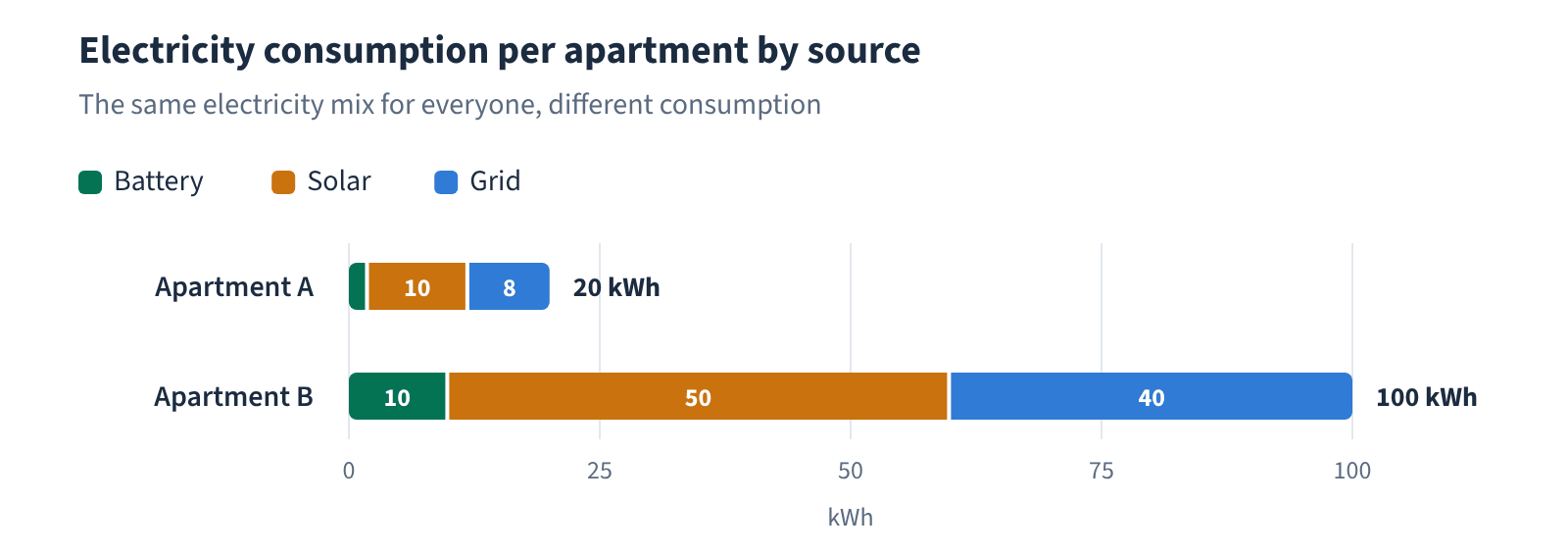
The energy mix above is now applied for the last 15 minutes to each individual billing unit. As a result, everyone has the same entitlement regarding the energy mix, regardless of how much energy they consume compared to other participants.
-
Apartment A total consumption:
20 kWh (2 kWh from battery, 10kWh from solar, 8 kWh from the grid)
-
Apartment B total consumption:
100 kWh (10 kWh from battery, 50kWh from solar, 40 kWh from the grid)
Note 1: The electricity mix reflects reality and the electricity mix actually prevailing in the ZEV. When electricity is consumed, the consumption corresponds exactly to this mix. Note 2: This application of the electricity mix gives large consumers a higher availability, in terms of quantity, of low-cost solar and battery electricity. Note 3: The application of the electricity mix is not intended to handle remuneration to investors or to distribute quotas to consumers.
Solar electricity price and remuneration to investors
Best practice for remunerating investors is to give them a share of the profit from the generated output and thereby compensate them. The prerequisite for this is that, even if everyone has invested, solar electricity is not offered internally at a price of 0 CHF.
If solar electricity and battery electricity have a price, large consumers settle their debt to the other investors through this price they have to pay.
Example with 3 investors and 3 billing units: The solar price is set at 17 Rp. / kWh.
-
Consumer A (200 kWh solar consumption, investment 33%): 200 kWh * 0.17 CHF / kWh = 34 CHF
-
Consumer B (20 kWh solar consumption, investment 33%): 20 kWh * 0.17 CHF / kWh = 3.4 CHF
-
Consumer C ( 50 kWh solar consumption, investment 33%): 50 kWh * 0.17 CHF / kWh = 8.5 CHF
In total, 45.9 CHF has now been generated from the sale of solar electricity.
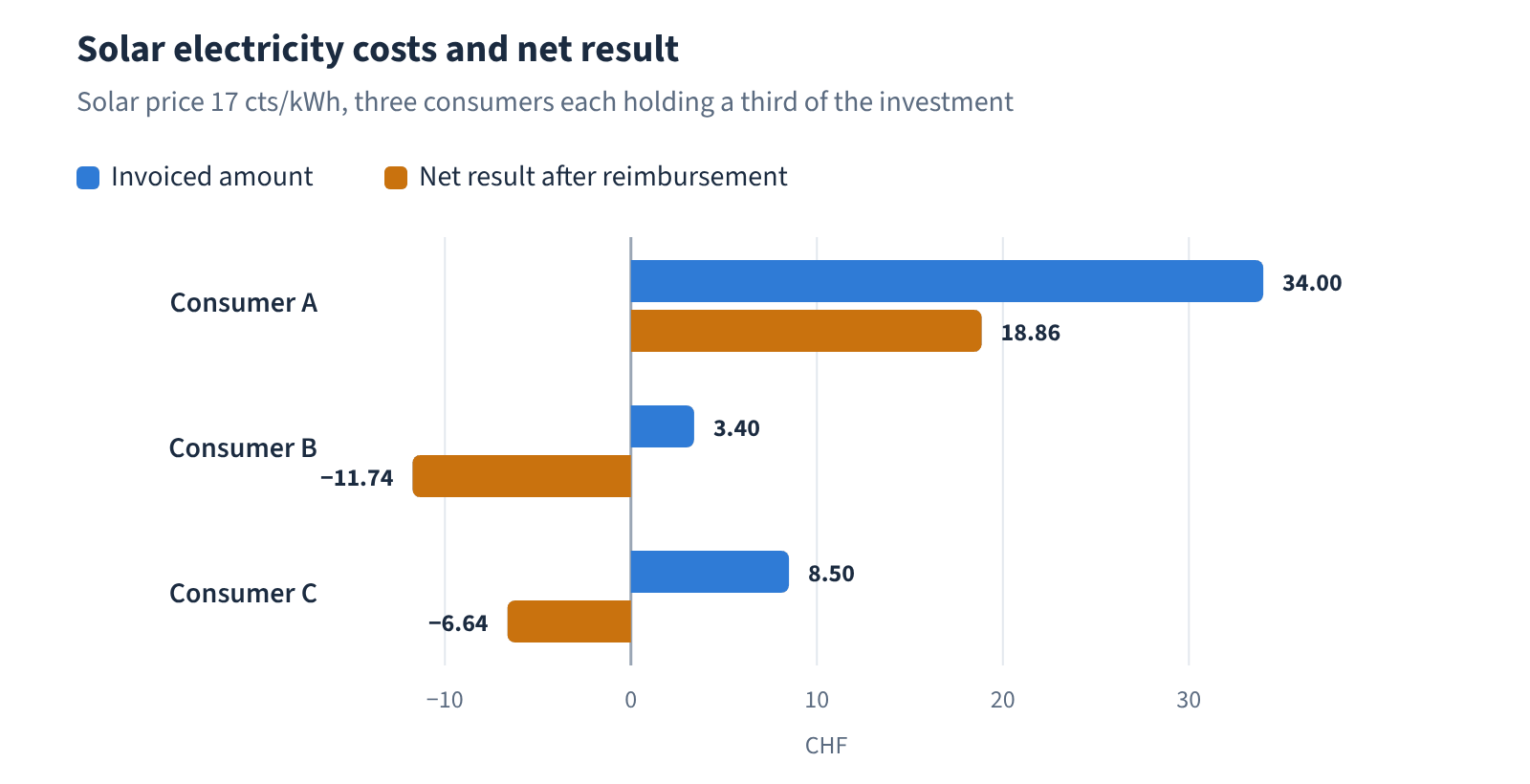
Since all three have invested equally, at 1/3 each, all of them are now entitled to one third of the money generated.
0.33 * 45.9 CHF = 15.14 CHF reimbursement for internally used solar electricity.
-
Consumer A (investment 33%): 34 CHF invoice amount - 15.14 CHF reimbursement = 18.86 CHF paid for solar electricity
-
Consumer B (investment 33%): 3.4 CHF invoice amount - 15.14 CHF reimbursement = -11.74 CHF profit from solar electricity, or reduction of the total invoice
-
Consumer C ( investment 33%): 8.5 CHF invoice amount - 15.14 CHF reimbursement = -6.64 CHF profit from solar electricity, or reduction of the total invoice
Note: The solar tariff should include the production price as well as returns. Example: 80% rule. The money can accordingly flow into the renewal fund (tax advantages) or be reimbursed according to the investment costs.