Guide for tenants
Contact for questions
smart-me does not carry out projects. Installations are carried out by installers, landlords or ZEV (association for own consumption) operators, who are also your first point of contact for questions.
Navigation
We recommend using the smart-me app on your smartphone. Simply download the app and log in on your smartphone.
Your tenant login details should be created and provided to you by your landlord or the operator of the ZEV.
Get the smart-me app here:
Alternatively, you can also log in via the smart-me portal in your browser.
Browser
In your account, under "Dashboard" ("Dashboard"), you will find your billing units and the metering points assigned to you.


Navigating between the views

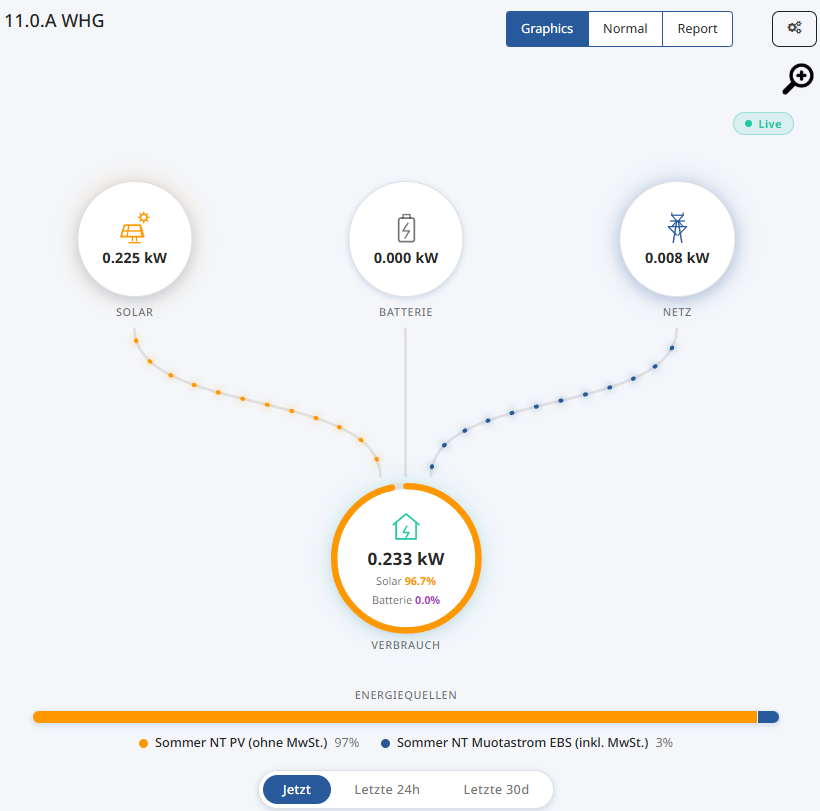
Graphics
Shows your current consumption with a visualization (optional, only if configured)
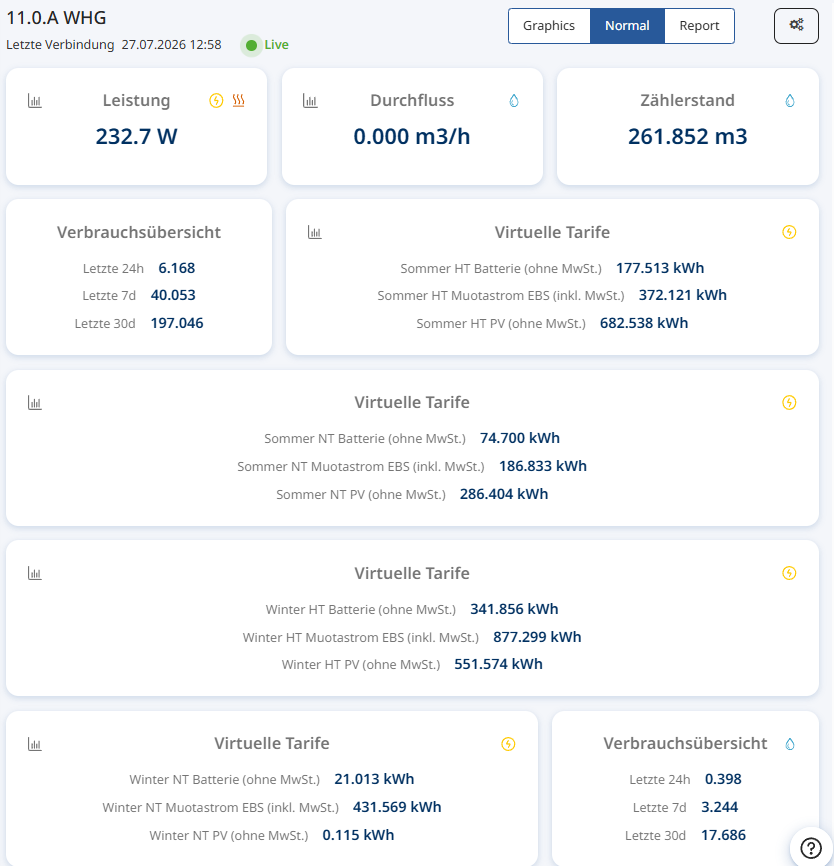
Normal
The normal view with all live values and historical charts
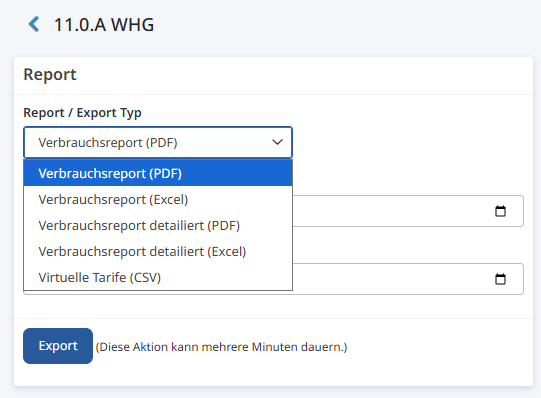
Report
Download area for folder or meter data.
The tariff consumption values are stored on the folders.
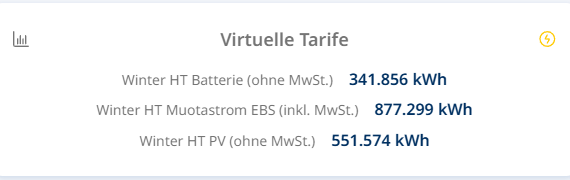
Tariff profile
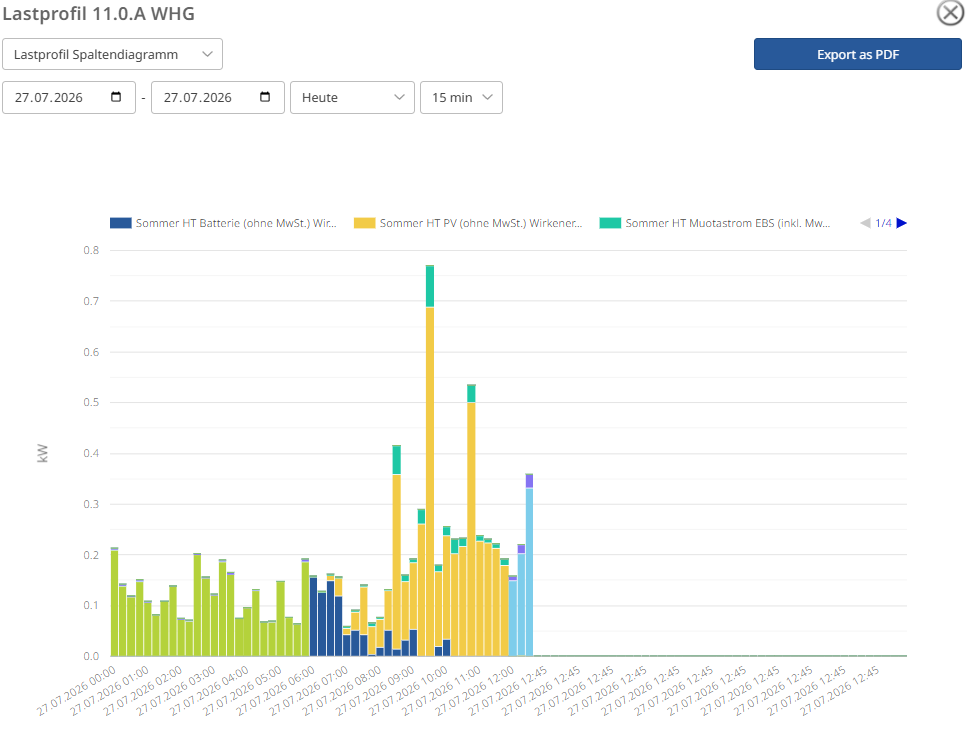
Click the "Virtual Tariffs" ("Virtuelle Tarife") tile to see your load profile with tariff information.
The load profile corresponds to your average energy consumption per time interval and is supplemented with the tariff information, i.e. the price you pay per time unit.
Load profile
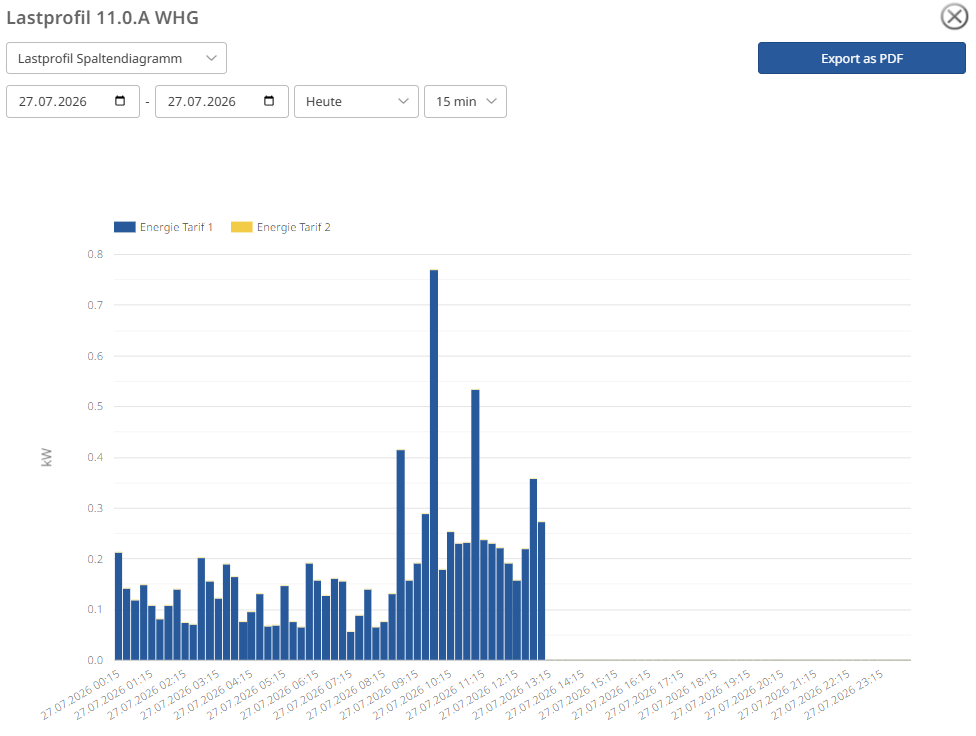
Click the "Power" ("Leistung") tile to see your load profile.
The load profile corresponds to your average energy consumption per time interval.

APP
To help you keep track, the smart-me app offers various visualizations that show you values in real time.
Overview of your billing unit
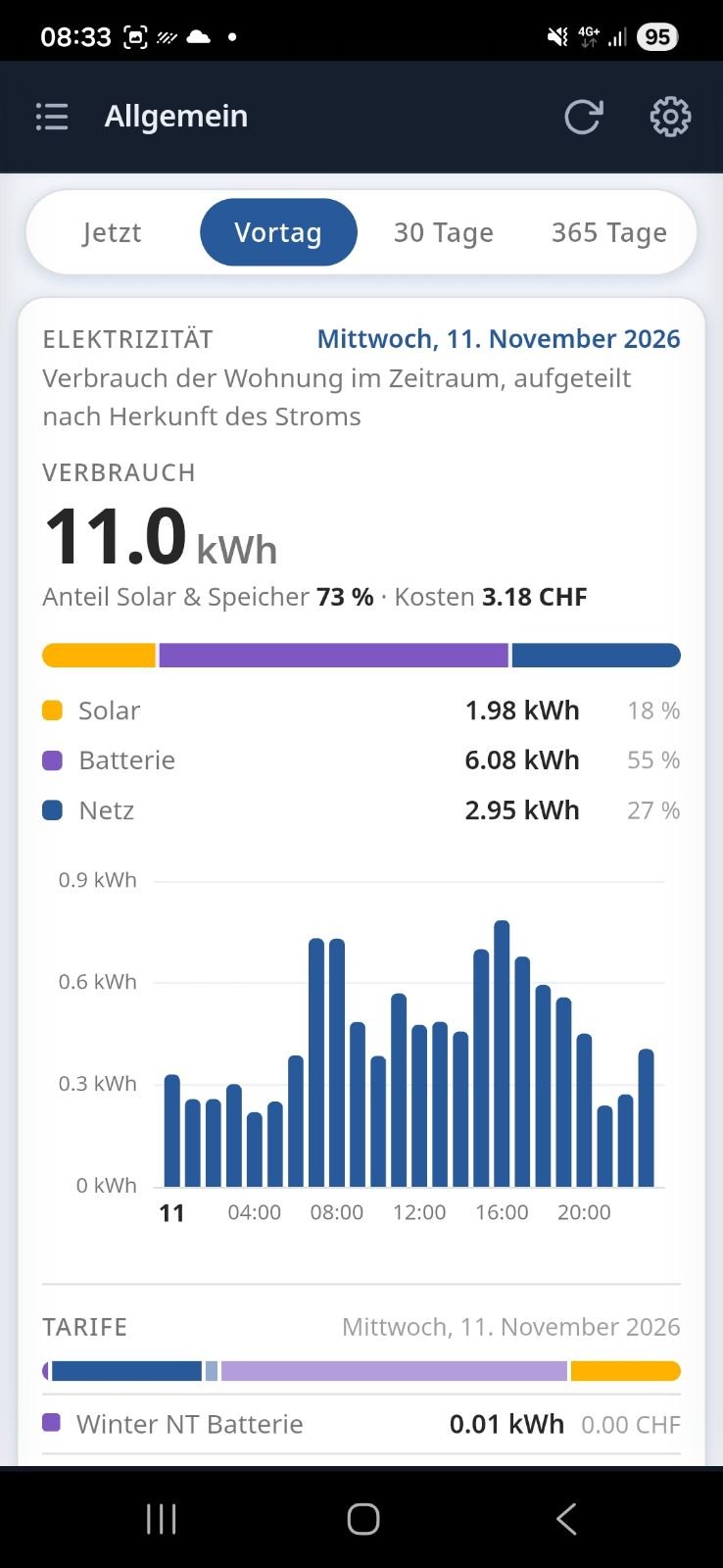
This view shows the values of your own billing unit, i.e. your apartment and not the entire property.
For the selected period (Now, Previous day, 30 or 365 days), you can see your consumption, broken down by the source of the electricity into solar, battery and grid, along with the share from solar and storage and the costs charged to you for it. The chart below shows the trend over the period, and the "Tariffs" ("Tarife") section shows the breakdown across your virtual tariffs.
Simple energy flow
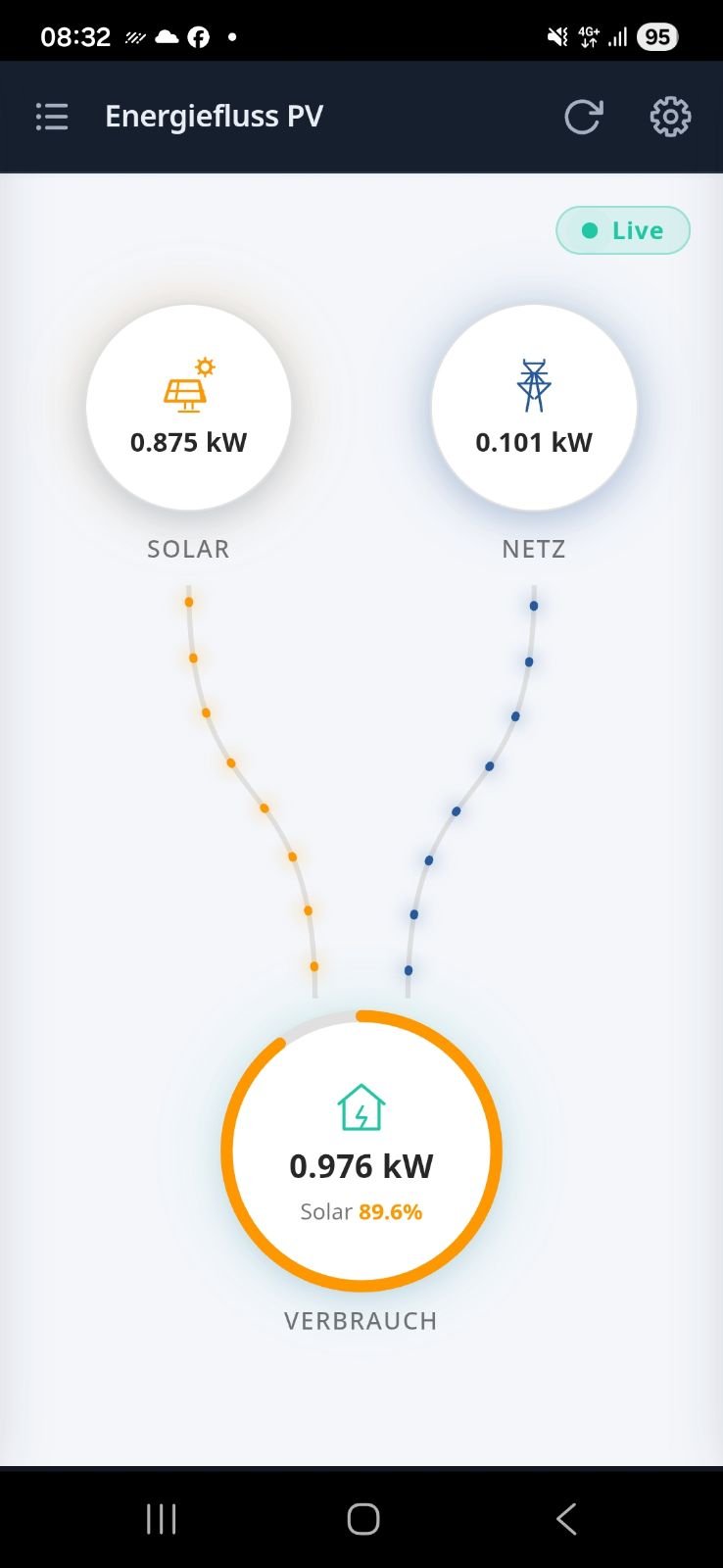
Shows the energy flow for a solar system, grid consumption and household consumption.
Two of these three meters must be specified; the third is calculated automatically. If all three meters are specified, incorrect values may be displayed. Wherever possible, we always recommend specifying direct measurements rather than virtual meters.
Self-consumption rate and self-sufficiency rate
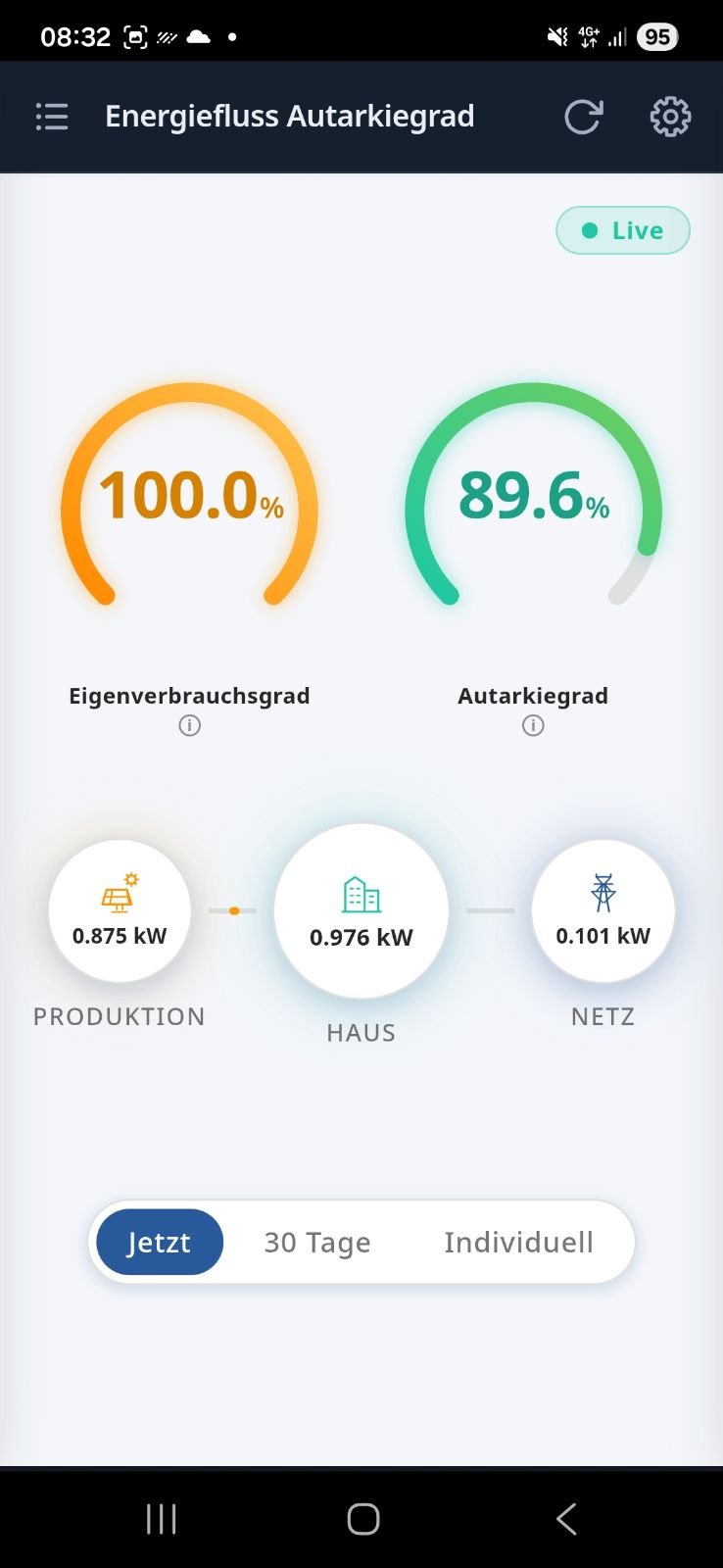
The self-consumption rate and self-sufficiency rate of a building are displayed. The values are calculated from the PV meter and the balance meter.
Self-consumption rate: how much of the solar energy is consumed directly in the building.
Self-sufficiency rate: how much of the total consumption is produced by the solar system.
Consumption and production monitoring
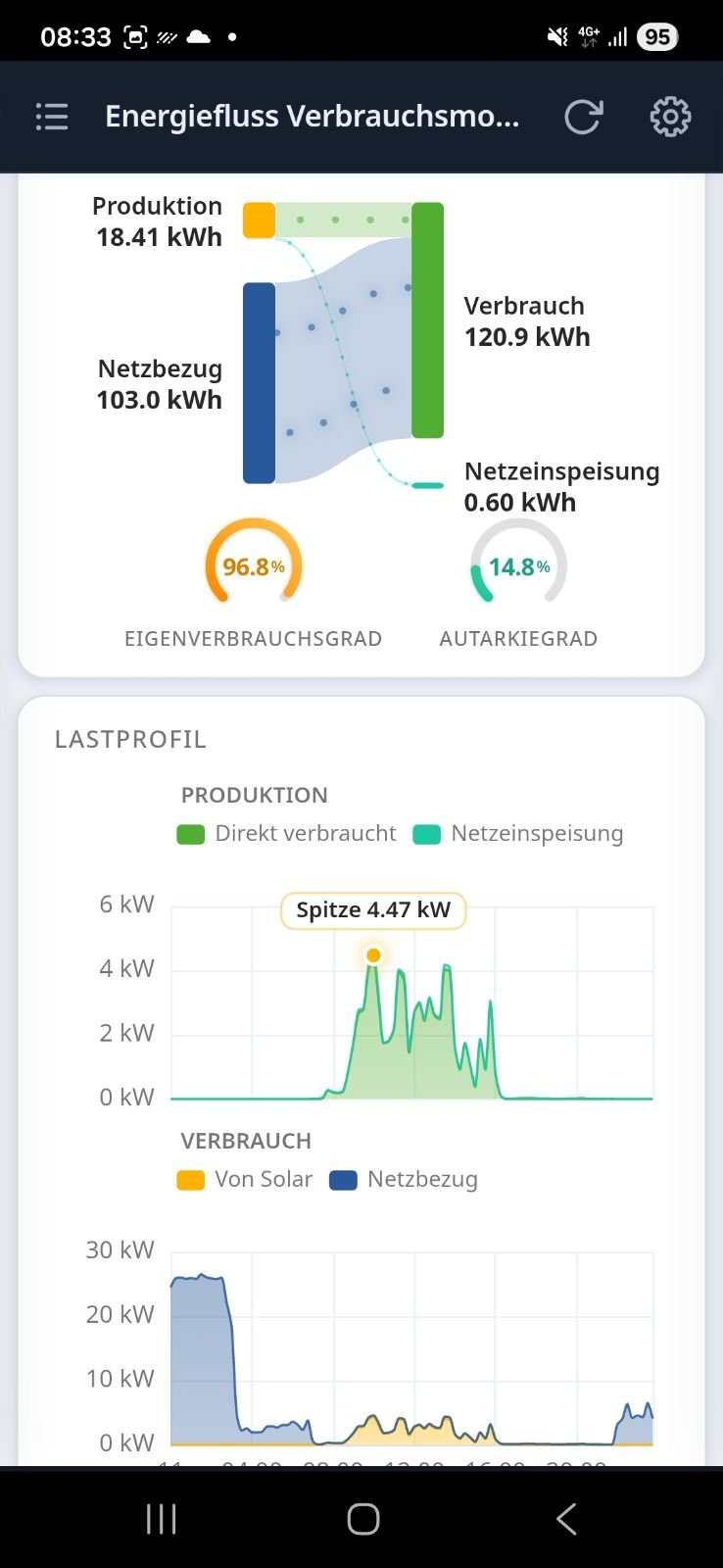
Shows where the produced energy is consumed (in the building or fed into the grid) and where the consumed energy came from (solar or from the grid).
Meter types
In the app, each meter can be viewed individually.
Meters of an apartment
-
Electricity meter (Elektro 470P2 WHG 11...) Measures the electricity consumed (kWh)
-
Heating meter (Heizung WHG 11.4...) Measures the energy consumed to operate the heating (kWh)
-
Cold water meter (Kaltwasser WHG 11.4...) Measures cold water consumption (m3)
-
Domestic hot water meter (Warmwasser WHG 11.4...) Measures domestic hot water consumption (m3)
Billing-relevant meters of a ZEV
-
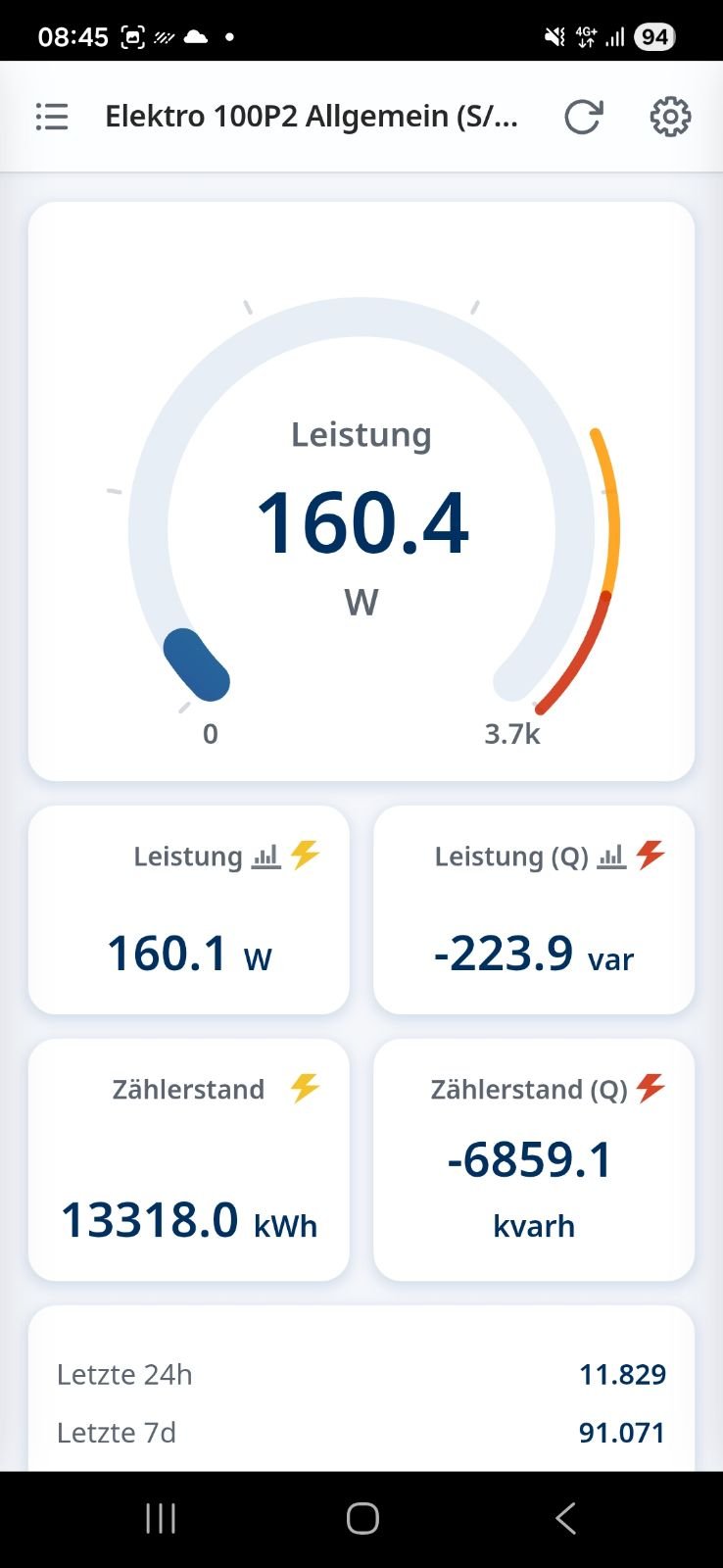
Photovoltaic system (Elekto 32P2 PVA) Required to measure the energy produced by the PV system.
-
Balance meter (Elekto 26P4 Bilanzm...) Required to know how much electricity was drawn from the grid or fed into it.
-
Total consumption (Verbrauch Feld 37) Required to determine the total consumption of the property/apartment (PV and grid consumption).
-
E-mobility and heating (Elektro 50P4 E-Mobil..., Emobilität (virtuell), Heizung (virtuell)) Combine the consumption of the charging stations and the heating so that these costs can be shown separately.
Meters in an apartment
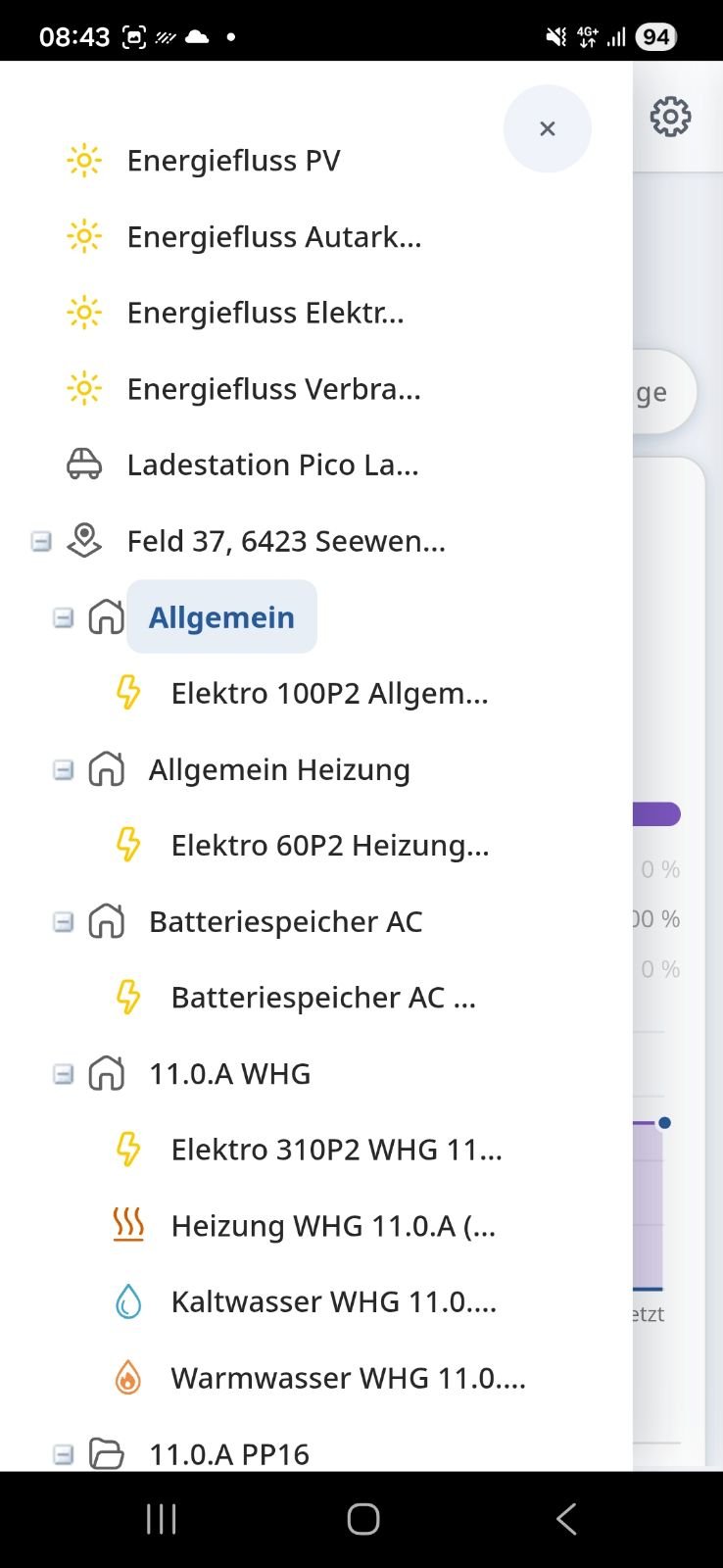
The visualizations are at the top of the menu, followed by the property with its folders and meters.
Meters of a ZEV
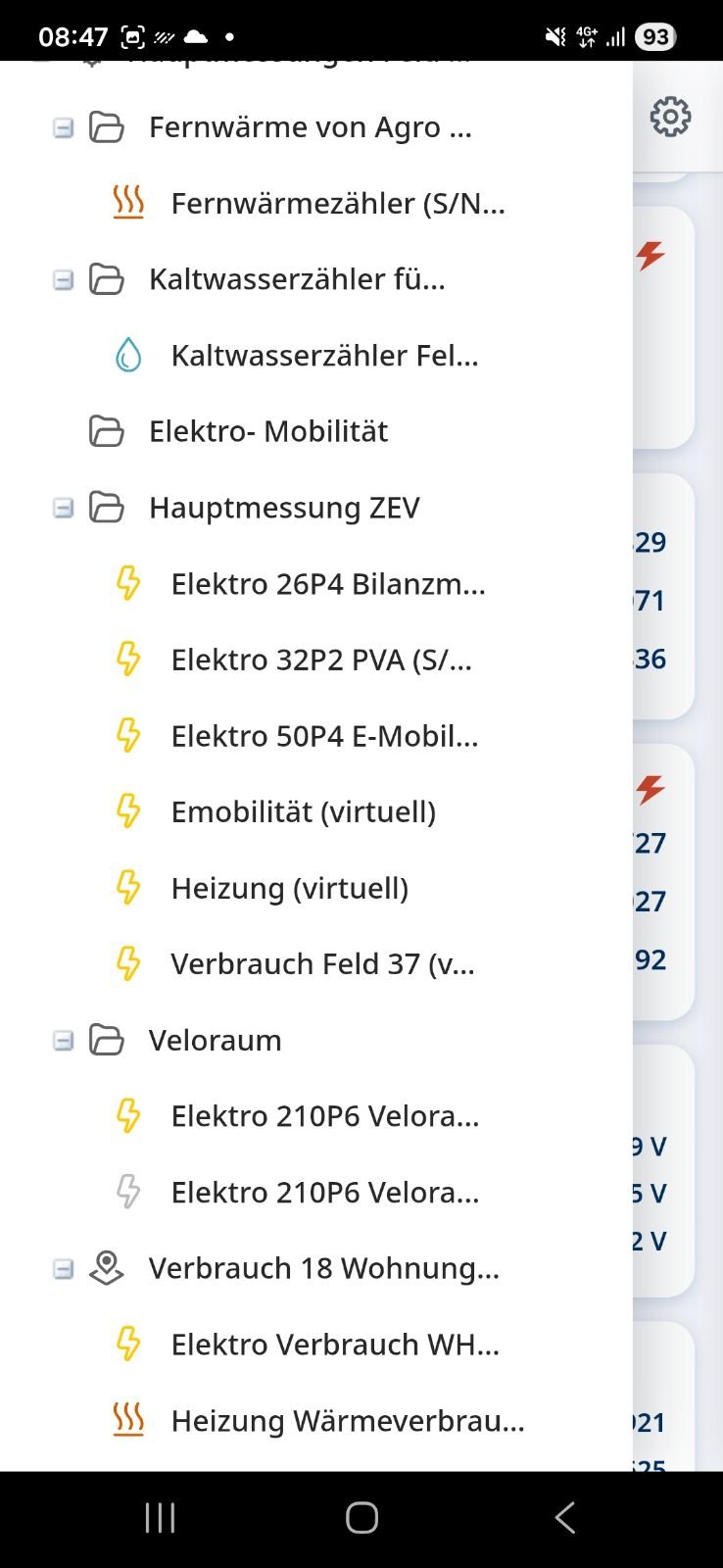
Measured values shown in the app (electricity meter)
Power (analog display) Shows the current active power that the meter is measuring. Here it is 160.4 W; the scale extends to the rated power of the meter.
Power The same value as a number (160.1 W). A negative value means feed-in to the grid.
Power (Q) The reactive power in var, here -223.9 var.
Meter reading The cumulative energy consumption in kilowatt hours (kWh), here 13318.0 kWh.
Meter reading (Q) The cumulative reactive energy in kvarh, here -6859.1 kvarh.
Energy consumption (last 24h, 7 days, 30 days) The consumption over the respective periods in kWh, here 11.829 kWh in the last 24 hours and 91.071 kWh in the last 7 days.
Further down in the view Depending on the meter type, the values per phase follow (voltage, current, power, Cos Phi), the relay status and the time of the last connection.
How do I read a VEWA billing statement correctly?
Billing according to VEWA (consumption-based energy and water cost billing) governs how the costs for heating and domestic hot water in an apartment building are distributed among the tenants. The aim is to divide the costs fairly and transparently, taking actual consumption into account and creating incentives to save.
In a first step, the landlord determines the actual costs incurred for heat and domestic hot water production during the billing period. Since these are based on real consumption and operating costs, the final amounts are only known at the end of the billing period.
These costs are then divided into two categories: basic costs and consumption-based costs.
-
Basic costs include fixed costs such as servicing and maintenance of the heating and domestic hot water systems. They are based on the total floor area of the building (m2) and are distributed proportionally according to the size of the apartment (m2).
-
Consumption costs reflect the actual energy consumption of the tenants and are calculated based on the meter values or other measurement methods.
Meters ensure that each tenant only pays the energy costs they actually caused. This promotes a fair distribution of costs and encourages a more conscious use of energy.
VEWA billing is standardized, which ensures a transparent and uniform cost distribution. This makes it easier for tenants to understand the billing statement and compare it with other apartments. Clear rules for recording and charging costs also help to avoid misunderstandings or disputes.
Determining the actual costs (landlord side)
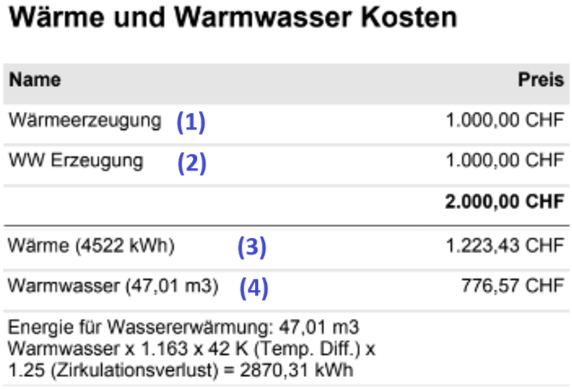
In our example, the landlord recorded total costs of 2000.- CHF at the end of the billing period: 1000.- CHF each for heat generation (1) and 1000.- CHF for domestic hot water generation (2).
The heat generated is shown in kWh and the domestic hot water in m3.
To bring the 47.01 m3 of domestic hot water to the desired temperature (e.g. 60°C), 2870.31 kWh were required.
The total costs of 2000.- CHF are therefore divided according to the energy (kWh) used in each case:
Heat (4522 kWh) 1223.43 CHF (3) Domestic hot water (47.01 m3 or 2870.31 kWh) 776.57 CHF (4)
Distributing the costs to tenants
In this example, the industry-standard allocation key is used to divide the total costs into basic costs (30%) and consumption costs (70%).
Example: heat
In the previous step, we determined a total amount of 1223.43 CHF for the heat of the property. This is now divided proportionally into 30% basic costs and 70% consumption costs for the entire property. This corresponds to the following costs:
-
Basic costs heat 367.03 CHF (5)
-
Consumption costs heat 856.40 CHF (6)
To distribute these costs fairly among the tenants, the basic costs are divided based on the living area and the consumption costs (kWh) based on the measured consumption.
The entire property has a living area of 250m2 and our apartment has a living area of 150m2. 60% ((100/250)x150) of the basic costs are therefore allocated to the apartment.
- Basic costs heat: 367.03 CHF x 60% = 220.22 CHF (7)
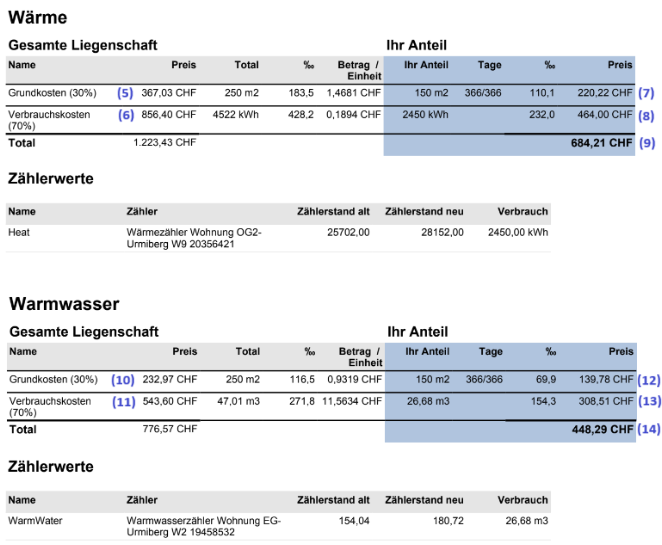
An energy consumption of 4522 kWh was measured for the entire property. Our apartment has a separate electricity meter, which measured a consumption of 2450 kWh. 54.18% ((100/4522)x2450) of the consumption costs are therefore allocated to the apartment.
Consumption costs heat: 856.40 CHF x 54.18% = 464.- CHF (8)
The total costs* for heat for the tenants of the apartment therefore amount to 220.22 CHF + 464.- CHF = 684.21 CHF (9).
Example: domestic hot water
The calculation for distributing domestic hot water is carried out in the same way as the calculation for heat. In the previous step, we determined a total amount of 776.57 CHF for the domestic hot water of the property. This is now divided proportionally into 30% basic costs and 70% consumption costs for the entire property. This corresponds to the following costs:
-
Basic costs domestic hot water 232.97 CHF (10)
-
Consumption costs domestic hot water 543.60 CHF (11)
To distribute these costs fairly among the tenants, the basic costs are divided based on the living area and the consumption costs based on the measured consumption (m3).
The entire property has a living area of 250m2 and our apartment has a living area of 150m2. 60% ((100/250)x150) of the basic costs are therefore allocated to the apartment.
- Basic costs domestic hot water: 232.97 CHF x 60% = 139.78 CHF (12)
A domestic hot water consumption of 47.01 m3 was measured for the entire property. Our apartment has a separate domestic hot water meter, which measured a consumption of 26.68 m3. 56.75% ((100/47.01)x26.68) of the consumption costs are therefore allocated to the apartment.
Consumption costs domestic hot water: 543.60 CHF x 56.75% = 308.51 CHF (13)
The total costs* for domestic hot water for the tenants of the apartment therefore amount to 139.78 CHF + 308.51 CHF = 448.29 CHF (14)
* To determine the total costs, the exact values were used, not the rounded values displayed.
smart-me web portal
If the information available in the smart-me app is not sufficient, you can log in to the web portal via a web browser.