Tenant Electricity Standard
All consumers participate in tenant electricity
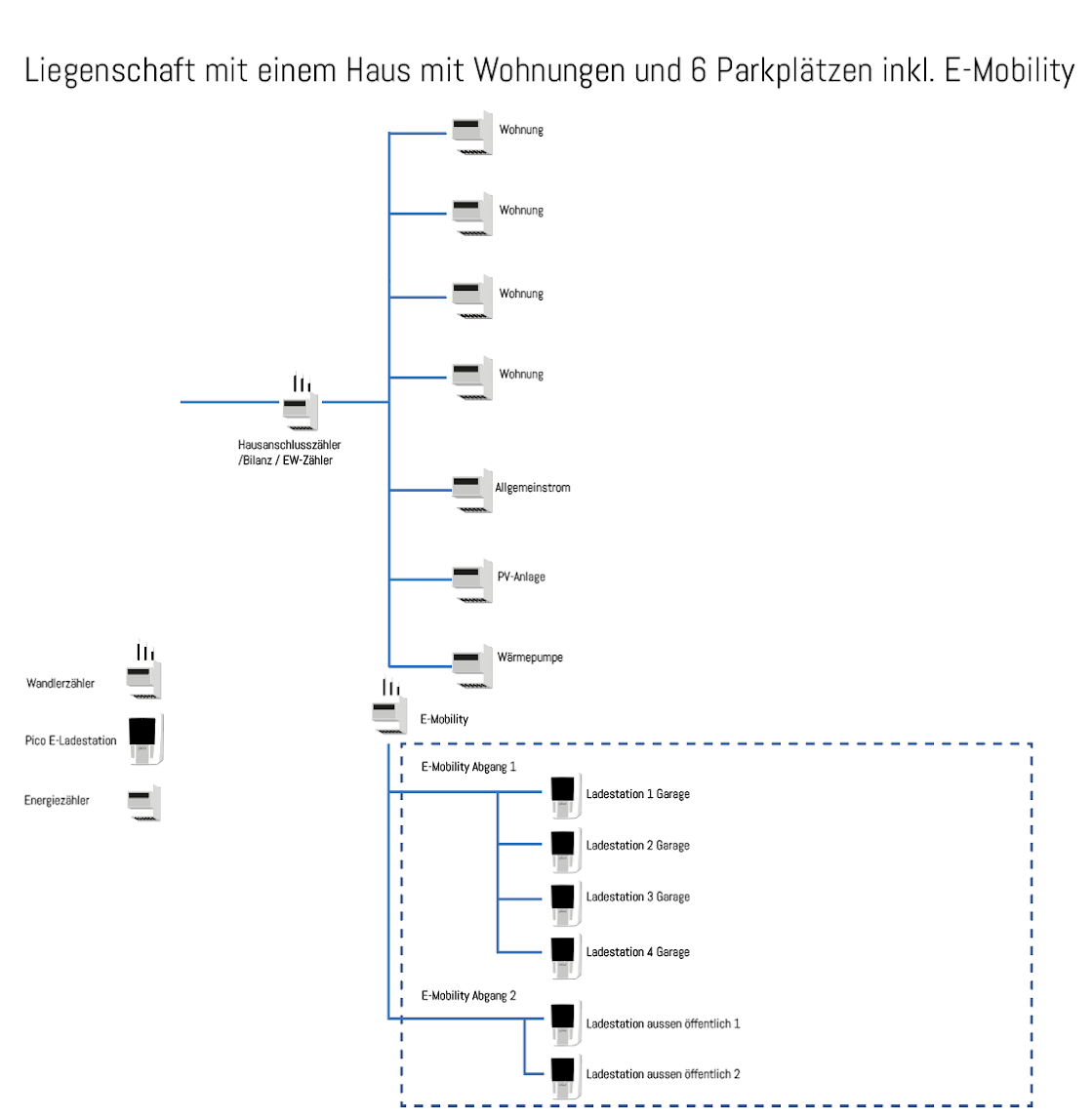
This structure applies to the standard metering concept: only parties that participate in tenant electricity are connected behind the building connection. If even one party does not participate, use tenant electricity with non-participants instead.
Folder structure
Two levels are mandatory: billing is set up at the top level and needs one folder below it for each invoice recipient.
-
1 folder for the property (e.g. Hauptstrasse 7 tenant electricity)
-
1 subfolder per billing unit, i.e. per apartment or invoice recipient
-
1 subfolder "General" for the stairwell, outdoor lighting and similar outgoing circuits
-
1 subfolder "Technical meters" for everything that will later only be distributed proportionally
-
Naming of the billing units:
-
One building: apartment name (e.g. WHG 1.1, WHG 1.2, WHG 2.1)
-
Several buildings: building name and apartment name (e.g. Hauptstrasse 7 WHG 1.1)
Assigning the meters
Assign the meters to the nodes using drag and drop.
Assign directly to the billing unit — if the invoice recipient pays for the entire consumption of this meter.
In the "Technical meters" node — if a meter supplies several billing units and is later distributed by percentage. Examples: common-area meter, heat pump for several apartments.
Production and balance
For the standard metering concept, there are two additional roles that do not exist in this form in the Swiss structure:
-
Balance meter — the building connection meter. It is referenced in the tariff configuration.
-
Production meter — all meters of the solar system and, if present, the battery.
Neither is assigned to an apartment; both remain at property level.
Charging stations
Do not assign charging stations directly to an apartment; instead, create a separate billing unit for them. This allows tenant changes to be handled without restructuring.
Charging stations from other manufacturers are not managed directly in smart-me. Create a node for the e-mobility outgoing circuit and assign the outgoing circuit meter to it — this way you at least get the total consumption.
Finally, create the alarms for a connection failure
This way you notice early when a meter fails and keep the gap in the measurement data small.