VEWA - Billing
Billing heat and water — two approaches
There are two basic configuration options for setting tariffs and billing multi-energy:
Billing without the VEWA function
- Billing using an externally calculated energy tariff per energy type. This is entered in the property below the virtual tariffs as a price in CHF/m3 or CHF/kWh.
Billing with the VEWA function (recommended)
- Heat and water costs that build up over the year can be recorded. The tariff is then calculated over the period and allocated to the billing units using allocation keys.
This page describes the recommended approach using the VEWA function.
VEWA webinar
-
Introduction to smart-me from 2min 20sec
-
VEWA from 12min 50sec
-
Live demo from 24min 58sec
-
Questions from 40min 32sec
General information on VEWA
VEWA stands for consumption-based billing of energy and water costs (Verbrauchsabhängige Energie- und Wasserkosten Abrechnung). It provides a guideline for the fair allocation of all types of energy costs and covers:
-
Heating
-
Cooling
-
Domestic hot water
-
Cold water
-
Electricity (can also be handled separately)
VEWA is the successor to the well-known VHKA billing and supports additional energy sources and simplified procedures.
VEWA handles cost allocation for separate or combined heating systems based on meter readings and allocates the costs as fairly as possible.
For heating, cooling and domestic hot water, special methods are applied to compensate for differences in apartment location, losses in pipes or other differences between consumers.
The following forms of cost allocation are available:
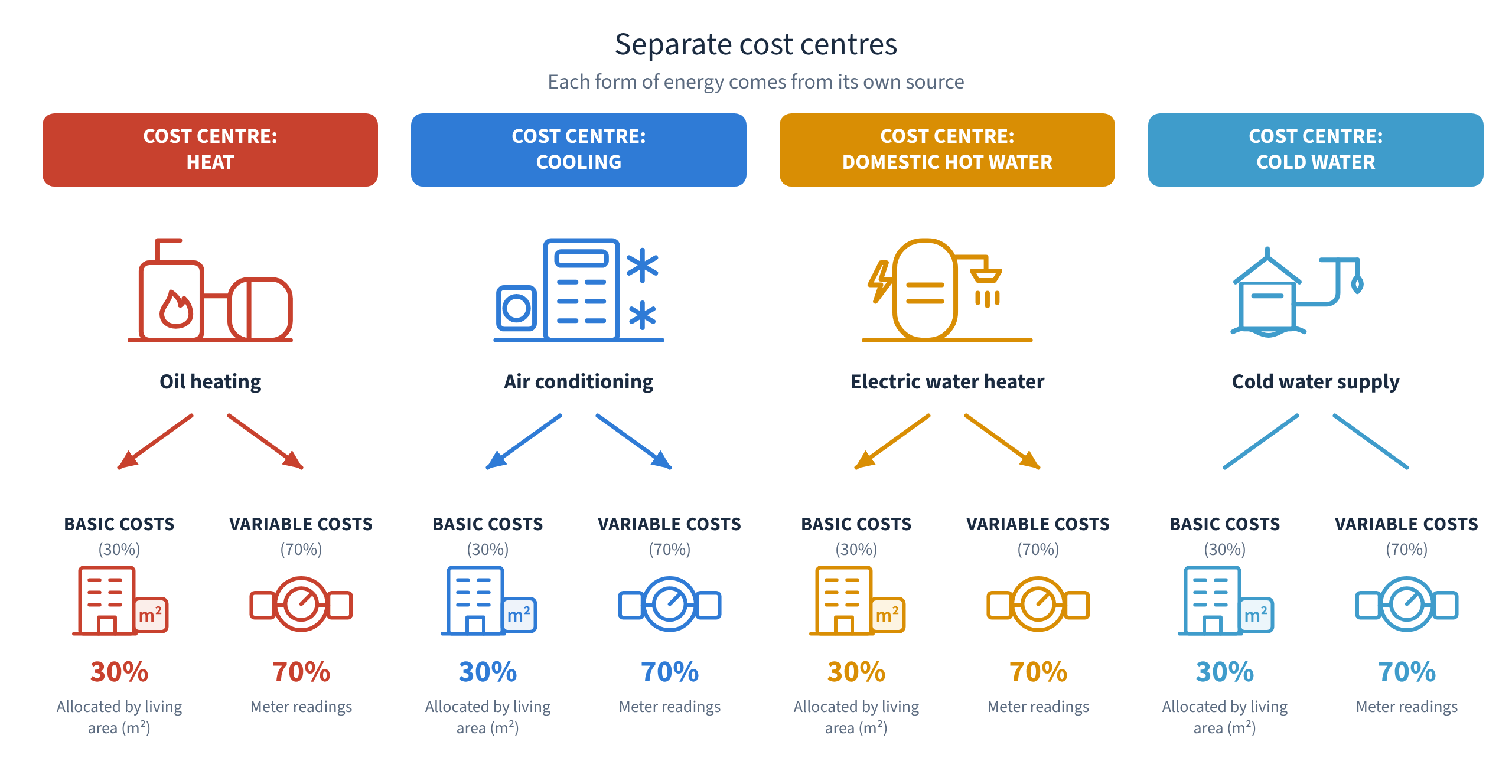
Separate cost centres
- Each energy comes from a different source
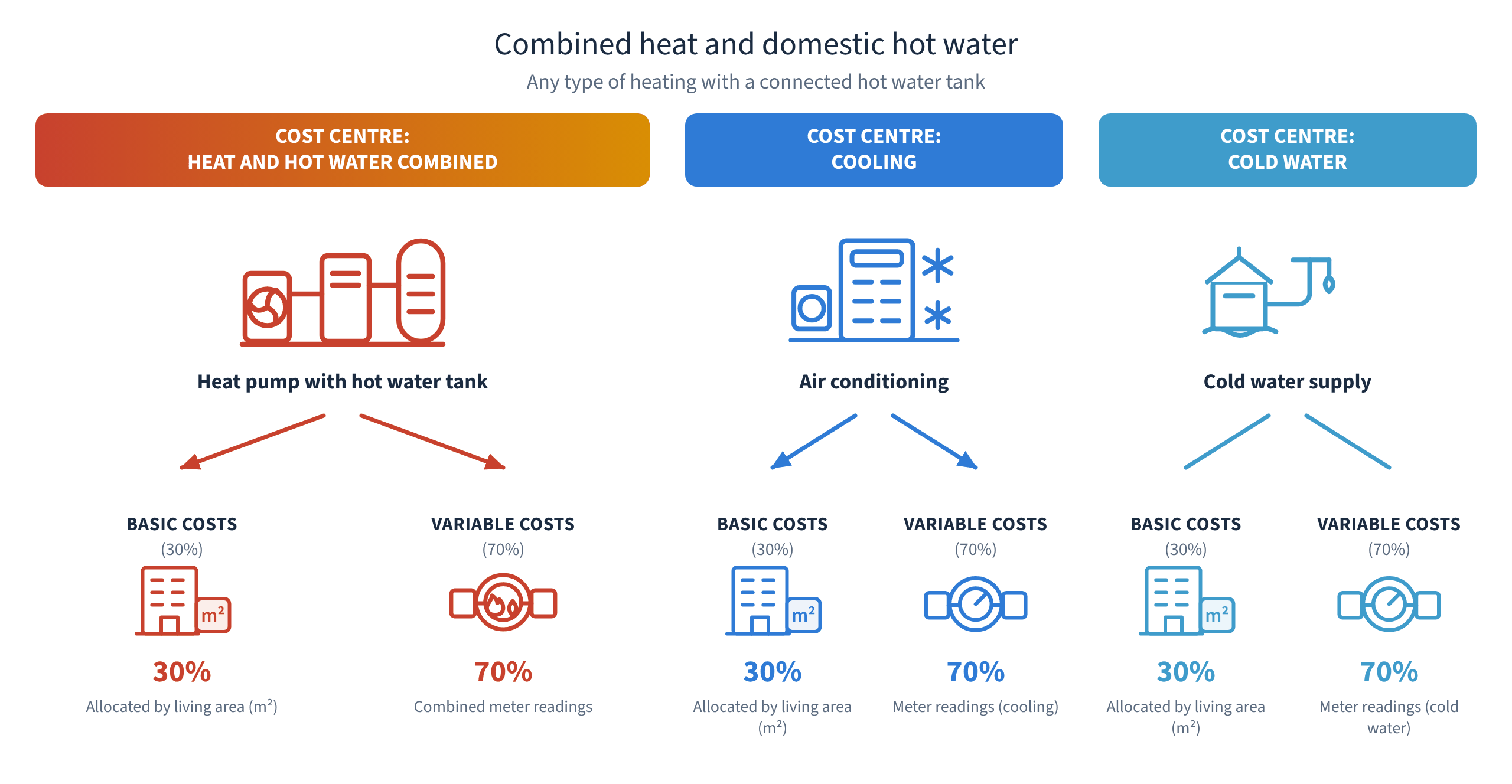
Combined heating and domestic hot water
- Heating of any kind with a connected hot water storage tank
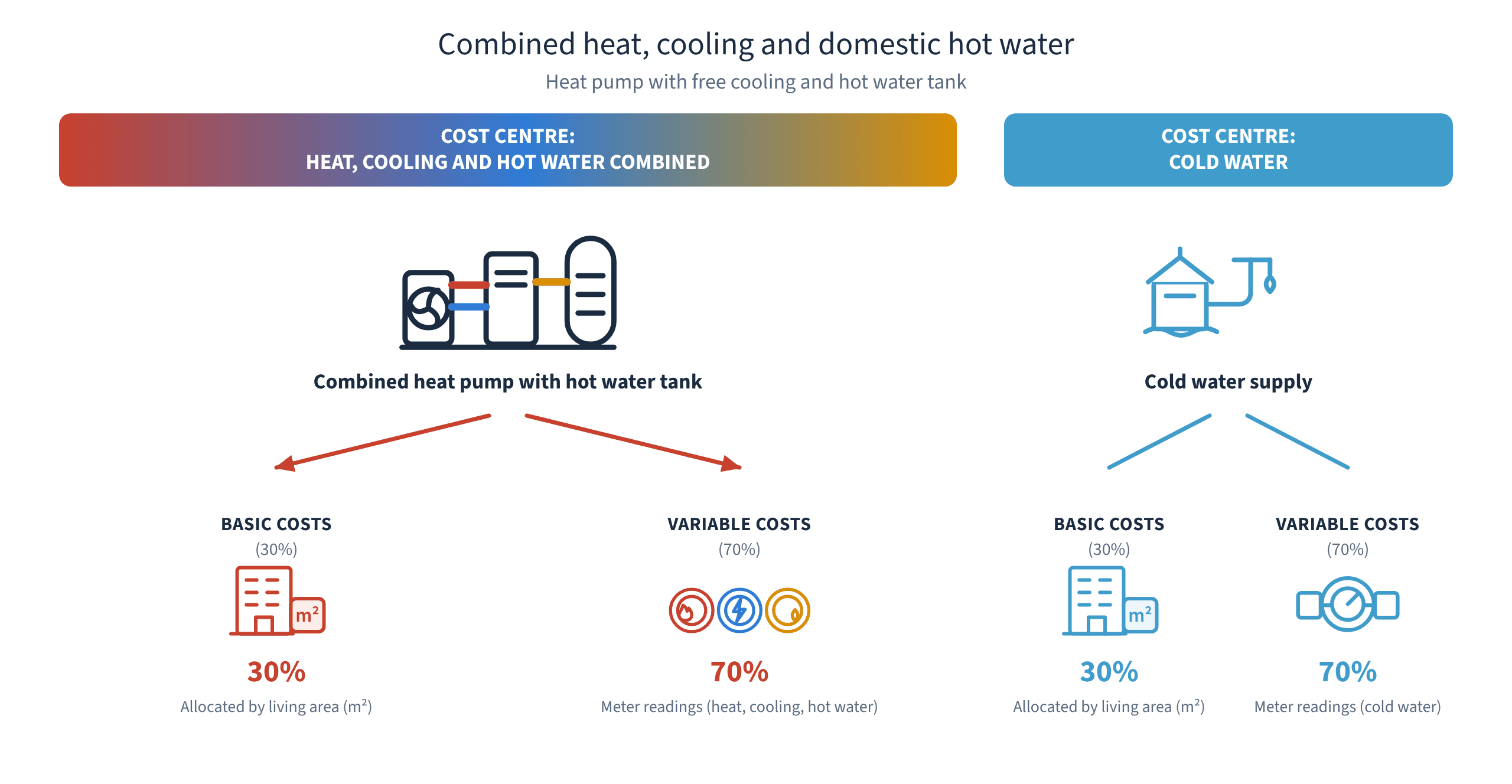
Combined heating + cooling and domestic hot water
- Heat pump with free cooling
Scope of functions
Which systems can be billed with smart-me VEWA?
-
separate heating and water systems (heating, cooling, domestic hot water, cold water)
-
combined heating and domestic hot water systems (heating + domestic hot water, cooling, cold water)
-
combined heating, domestic hot water and cooling systems (heating + cooling + domestic hot water, cold water)
For an energy type to be billed successfully, consumption meters for every energy type must be installed in the units.
Note:
-
Heat cost allocators are not supported
-
When billing with total generation meters, the costs can be allocated to the residential units by percentage.
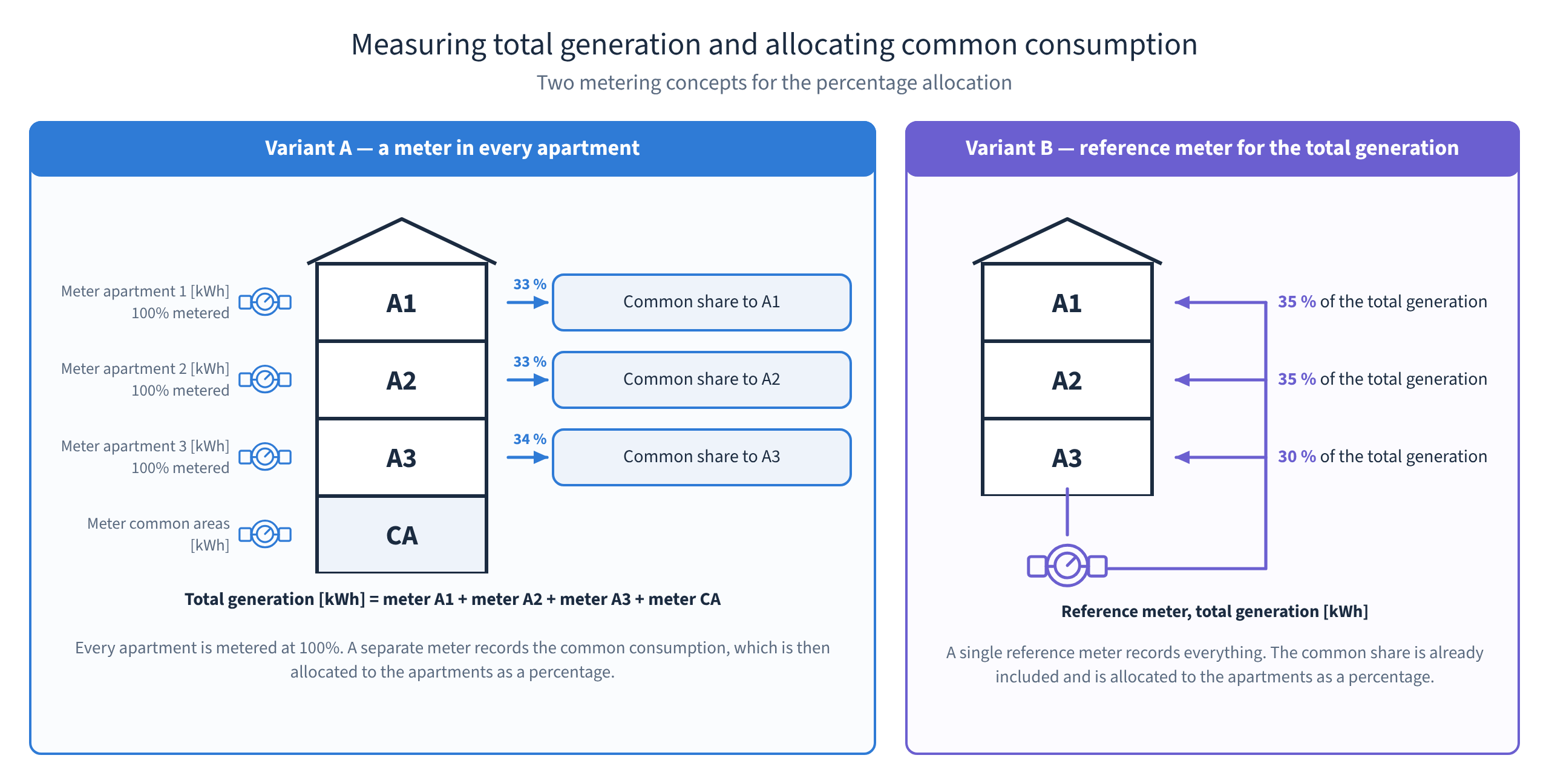
Common areas:
Collections of meters in folders can be allocated to billing units by percentage at a later stage (Billing).
This is supported for both system variants above.
How many systems can be configured in one account?
One VEWA system can be billed per property. If there are several heating systems, several properties are created in the same account.
These can then be billed individually with different billing periods.
General way of working with smart-me VEWA
-
VEWA can be applied to any property. Make sure that all consumption meters of the same heating system are in the same property. If several buildings share the same heating system, the buildings must be merged into one.
-
When using VEWA, all rental contracts and vacancies must be recorded correctly in the tenant list. Either in smart-me Billing or in the external property management software when using DTA-VKA files.
Configuring VEWA
1. Activate VEWA and configure the cost allocations.
Select the heating system:
-
Heating, cooling and domestic hot water combined (Wärme, Kälte und Warmwasser kombiniert)
-
Heating, domestic hot water combined (Wärme, Warmwasser kombiniert)
-
Separate systems (Separierte Systeme)
Whether combined or not depends on how the heat is generated. If, for example, a heat pump is used for heating, cooling and domestic hot water preparation, combined billing is the appropriate choice, since the input quantity is the same for all three energies, namely electricity.
If, however, heating is provided by an oil heating system while the domestic hot water is prepared purely electrically without support from the oil heating, non-combined billing is the right choice.
Cost allocation
Cost allocation splits the total costs into fixed costs (basic costs) and variable costs (consumption-based costs).
Basic costs
The basic costs take into account any pipe losses, circulation losses, the preferred location of an apartment with more sunshine and so on, and allocate a share of the costs to all tenants according to their share of the floor area of the entire property.
Variable costs
The variable costs are applied directly to the recorded quantities of energy consumed. They correspond to each tenant's individual consumption.
Domestic hot water preparation
So that the energy that went into domestic hot water preparation can be estimated from m3 values, the following standard formula is applied:
Domestic hot water energy in kWh = Total consumption values domestic hot water [m3] * 1.163 * temperature difference [K] * 1,25
The temperature difference can be selected and refers to the difference between the temperature of the cold water entering the building (usually +10°C) and the average temperature of the boiler after heating (usually +52°C).
In this example, the difference is:
Temperature difference = target temperature - inlet temperature = 52°C - 10°C = 42 K
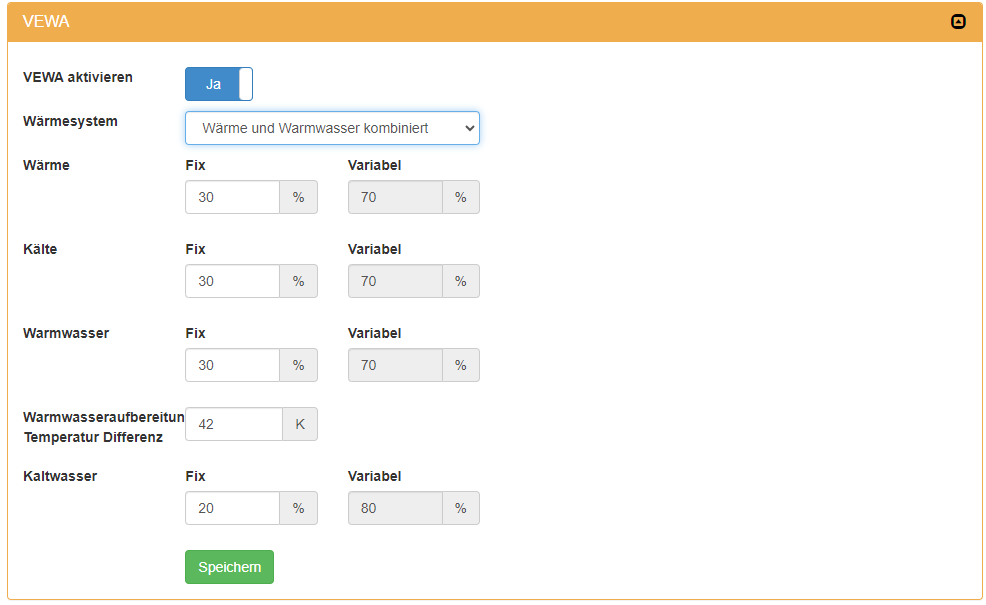
Guideline values for configuring basic costs and variable costs:
New buildings (anything from 2018 onwards):
- Basic costs 30%, variable costs 70%
Renovated old buildings (insulation upgraded to new-build standard):
- Basic costs 40%, variable costs 60%
Unrenovated old buildings (before 2018):
-
Basic costs from 40%-50%, variable costs from 50-60%
-
In addition, a location adjustment must be calculated for each apartment. Either the reading of the apartment meter is reduced or the allocation percentages of the total meter are weighted. (Details in chapter 10 of the VEWA document under further reading)
The apartment meter readings can be adjusted here to apply the location adjustment: Folder and Meter Configuration
- If a meter has to reduce its reading by 20%: Set the value correction (Wertkorrektur) from 100% to 80%.
2. Recording a billing period
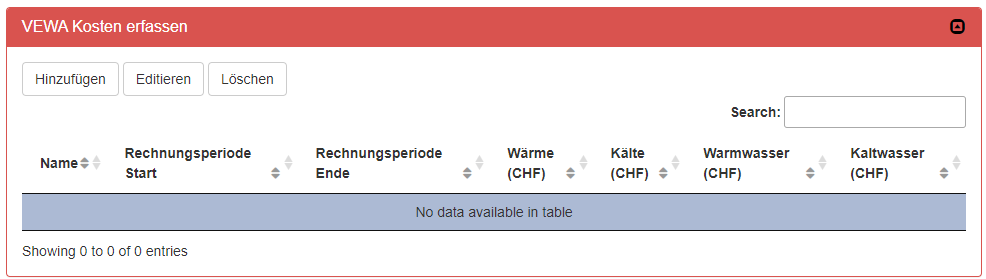
The costs can be recorded as full costs per energy type. For combined systems, the individual costs of the individual energy sources are added together.
3. Creating billing periods and defining the content of the billing period
-
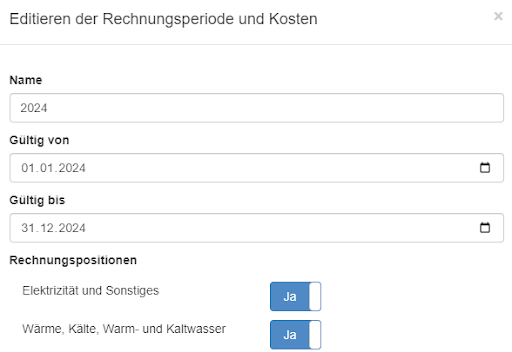
Create the billing period
-
Activate or deactivate content
If electricity and the heating and ancillary costs are billed at different intervals, several periods are recorded.
e.g.:
-
Electricity period Q1 2024 (electricity and other only)
-
Electricity period Q2 2024 (electricity and other only)
-
Electricity period Q3 2024 (electricity and other only)
-
Electricity period Q4 2024 (electricity and other only)
-
Heat water period 2024 (heating, cooling, domestic hot and cold water only)
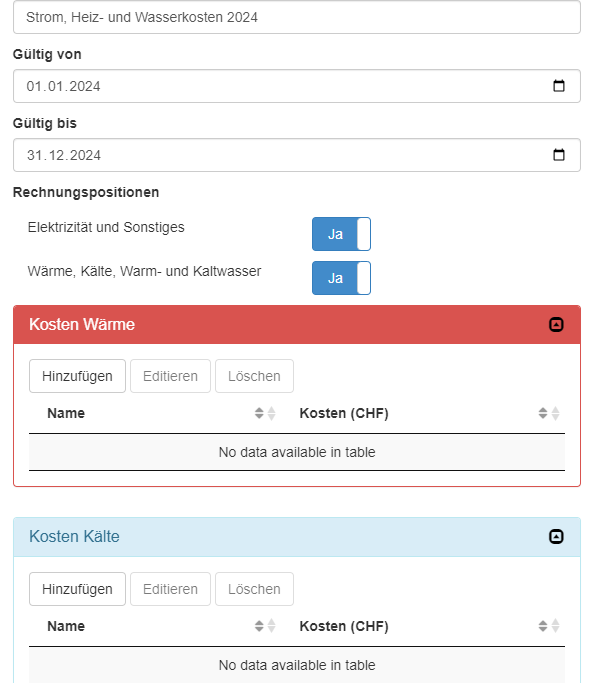
4. Recording the costs of the billing period
Note on exporting to property management software with DTA-VHKA files: If you want to use VEWA but export the data to another system as per mille shares or consumption values, you do not need to record any costs. However, the billing period must be created beforehand.
The costs that may be recorded fall roughly into the following categories:
Energy costs
Costs for the purchased energy source, e.g.:
-
1000 litres of oil for 2000 CHF
-
500kWh of electricity for 200 CHF
-
10 m3 of cold water for 50 CHF
Energy ancillary costs
Costs for operation and maintenance
-
Costs of the periodic inspection of the heating system
-
Costs for the meter reading service (e.g. amortisation of the smart-me licence costs for the devices)
-
Administrative work related to the heating system
-
Chimney sweep costs
-
Waste disposal, if the heating system incurs such costs.
What is not part of the energy ancillary costs
- Metering infrastructure (this is handled through a rent increase)
Note on domestic hot water costs:
The domestic hot water costs only include the costs of heating the water. The amount of cold water used for domestic hot water preparation is automatically transferred to the cold water section.
-
If a total cold water meter is split among several apartments by percentage, the total amount of cold water is calculated from this shared meter.
-
If there are cold and domestic hot water meters in the apartments and they are applied with 100% of the consumption, the total for cold water is the sum of all domestic hot water and cold water meters.
These can be entered per energy type and are added up.
5. Charging meter rental
Unlike in a ZEV (association for own consumption), under VEWA the costs for amortising heat and water meters may be charged to consumers.
However, this must be done via a rent increase, not via the ancillary costs.
The hardware costs and the installation of a meter may be passed on.
An amortisation period of 10 years applies.
The rules for passing on costs are described in Art. 269d OR and Art. 19 and 20 VMWG
Details on the calculation in the official VEWA document under 2.2 FORMELLE ÜBERWÄLZUNGSREGELN
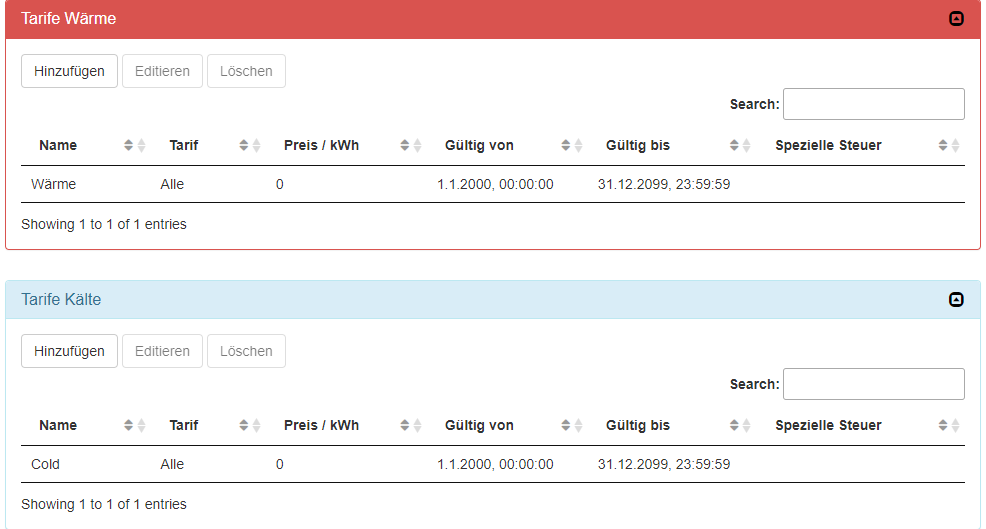
6. Recording a permanently valid tariff for each energy source
-
This tariff is entered without a price (0) with unlimited validity (2099).
-
Every energy source with a valid tariff is shown on the invoice.
7. Entering apartment floor areas
The apartment floor areas must be known for the VEWA calculation and the allocation of the basic costs. They can be set in the respective billing unit. They are then added up to the relevant total floor area.
Note: To report the relevant total floor area correctly, all premises must be recorded as billing units, even if they have no meters assigned and are handled externally at a flat rate. Only whole numbers are possible.

Invoice content and breakdown
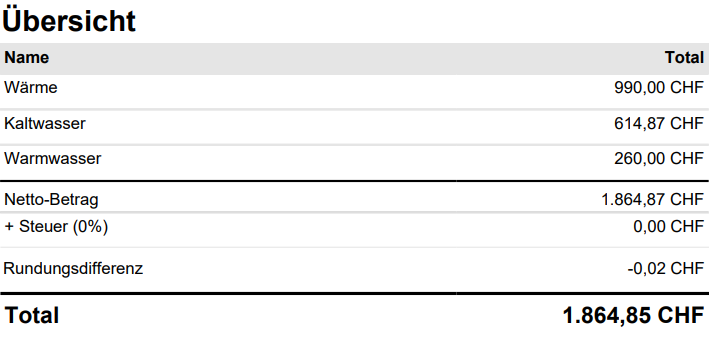
Overview
The overview contains all costs at a glance, including any applied taxes and rounding differences.
Heating
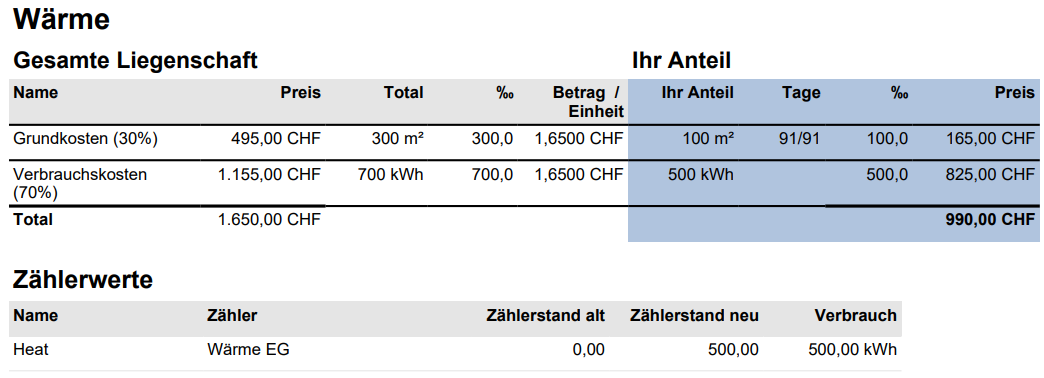
The heating section shows the total costs for the heating cost centre and the allocation keys and reference values applied.
-
Basic cost share in % (here 30%)
-
Consumption cost share in % (here 70%)
-
Total consumption of the property in kWh (here 700 kWh)
-
Total living area of the property in m2 (here 300 m2)
The calculated tariffs are then applied to the respective apartment (blue block) based on the apartment's measured meter values.
-
Living area of the apartment in m2 (here 100 m2)
-
Occupancy days (here 91 of 91, 100% occupancy)
-
Meter reading of the respective apartment (here 500kWh)
Domestic hot water
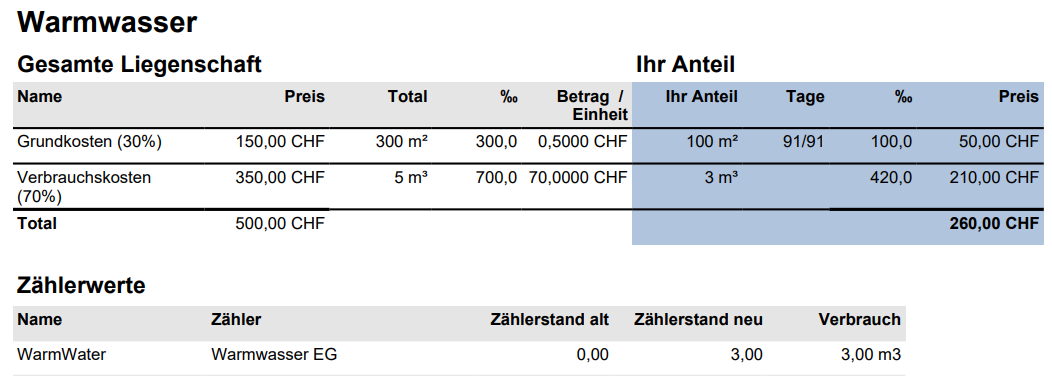
The domestic hot water section shows the total costs for the domestic hot water cost centre and the allocation keys and reference values applied.
-
Basic cost share in % (here 30%)
-
Consumption cost share in % (here 70%)
-
Total consumption of the property in m3 (here 5 m2)
-
Total living area of the property in m2 (here 300 m2)
These costs consist exclusively of the costs required to produce domestic hot water, not the cold water used for it. More on the costs in the cost centre overview section.
The calculated tariffs are then applied to the respective apartment (blue block) based on the apartment's measured meter values.
-
Living area of the apartment in m2 (here 100 m2)
-
Occupancy days (here 91 of 91, 100% occupancy)
-
Meter reading of the respective apartment in m3 (here 3 m3)
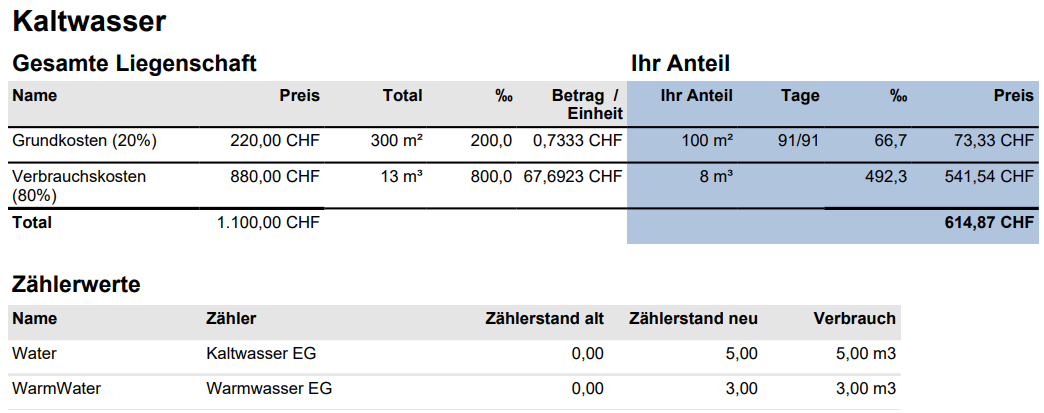
Cold water
The cold water section shows the total costs for the cold water cost centre and the allocation keys and reference values applied.
-
Basic cost share in % (here 20%)
-
Consumption cost share in % (here 70%)
-
Total consumption of the property in m3 (here 13 m2)
-
Total living area of the property in m2 (here 300 m2)
The calculated tariffs are then applied to the respective apartment (blue block) based on the apartment's measured meter values.
-
Living area of the apartment in m2 (here 100 m2)
-
Occupancy days (here 91 of 91, 100% occupancy)
-
Meter reading of the respective apartment in m3 domestic hot water (here 3 m3)
-
Meter reading of the respective apartment in m3 cold water (here 5 m3)
Note:
Depending on the system, only cold water meters or a mix of cold and domestic hot water meters may appear here; these systems are detected automatically.
-
If there is a main meter for cold water and none in the apartments, or only domestic hot water meters in the apartments, only a percentage share of a cold water meter would appear here.
-
If there are apartment meters for domestic hot and cold water, both meters per apartment always appear here; their sum is the total water consumption.
Cost centre overview
Separate cost centres
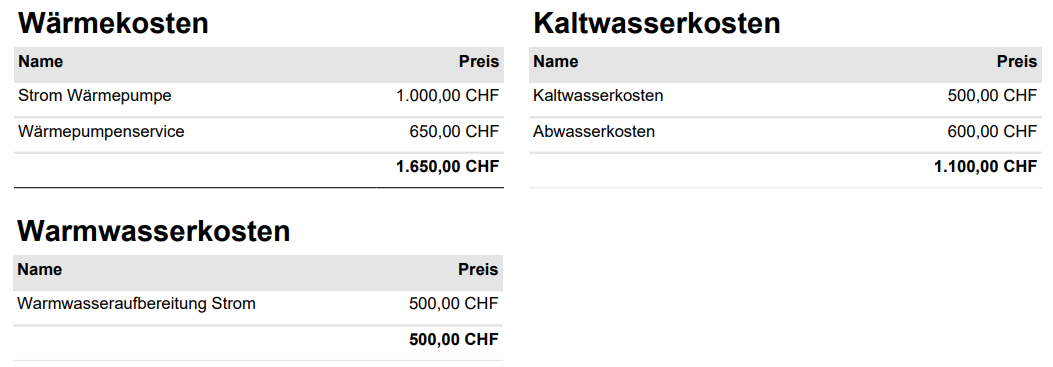
Every invoice includes the cost centre overview. It contains all entered cost items for the individual cost centres.
-
Under heating, all costs relating to the heating system are listed.
-
Under domestic hot water, only the costs for heating the water are listed, not the amount of cold water used.
-
Under cold water, all costs for cold water and waste water are entered.
Combined cost centres
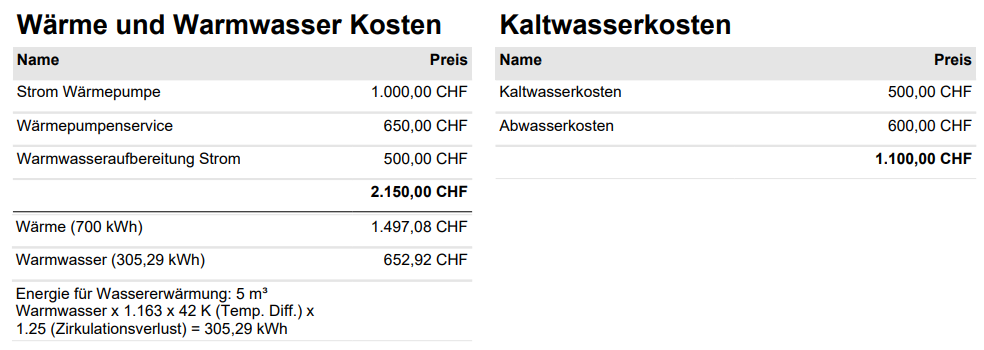
The cost centre overview can look different when systems are combined.
A common example is combining heating and domestic hot water, since part of the energy for domestic hot water preparation comes from the heating system. (Hot water storage tank coupled to the heating)
In this case, the costs are shown combined.
What is special here is that the conversion formula used to split the total energy into heating energy and domestic hot water preparation energy is shown.
Separate cost centres cost overview
Combined cost centre overview heating + domestic hot water (conversion formula below the cost overview)
Using VEWA with a property management software interface
Data exchange with VEWA and DTA-VHKA files