VAT ZEV / Ancillary Costs
In this section, we take a closer look at VAT in the ZEV (association for own consumption). Deciding whether and how VAT must be shown on invoices and paid to the state is fairly complex.
In this section, we walk through the initial questions and the decisions that follow from them.
How does VAT work?
Value added tax is primarily a tax on turnover.
A company that is liable for VAT must charge a tax on its turnover (sales of products and services), collect it and then pay it to the state.
At the same time, companies liable for VAT are entitled to deduct the VAT on purchased goods and services as input tax.
The aim is for VAT on a product to be taxed only once in total, based on its value to the end consumer.
Details of the example
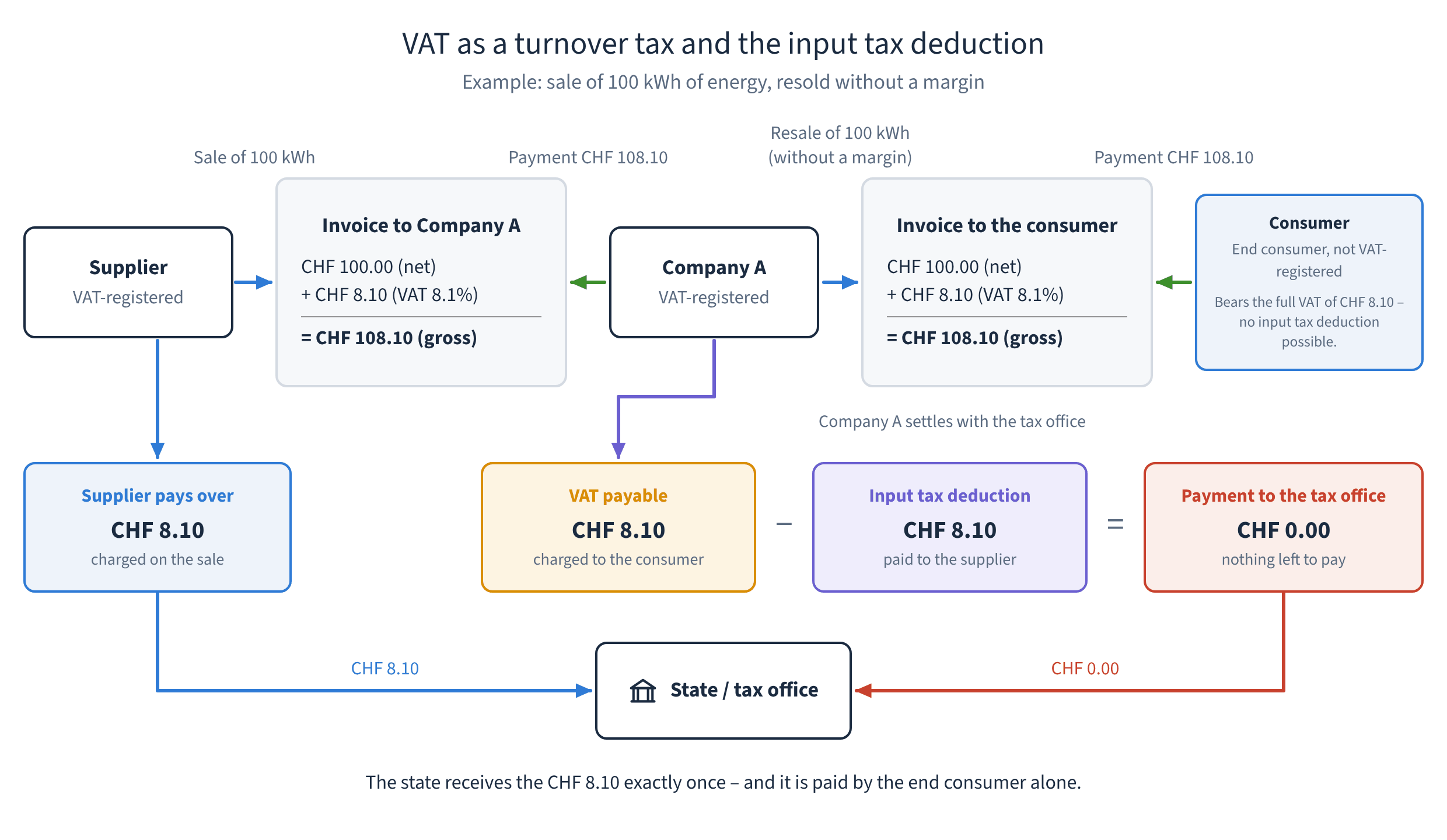
If company A orders 100 kWh of energy for CHF 100 net from its supplier, it receives an invoice from the VAT-registered energy supplier for the 100 kWh of energy (CHF 100 net) + VAT (8.1%, 8.10 CHF), totalling 108.10 CHF.
Company A pays 108.10 CHF, the energy supplier pays the 8.10 CHF to the state and keeps 100 CHF for its services.
If company A were now to resell this energy to a consumer (here without profit, for easier understanding), company A offers the consumer the 100kWh of energy again at a price of 100 CHF and in turn charges VAT itself, since company A is itself liable for VAT.
The invoice to the consumer is therefore as follows:
100 kWh of energy (100CHF net) + VAT (8.1%, 8.10 CHF), totalling 108.10 CHF.
The consumer pays the 108.10 CHF to company A.
Company A receives 100 CHF for the energy and pays the VAT of 8.10 CHF to the state.
Now the important point: Company A may now claim the input tax deduction on the VAT amounts it owes before settling its liability.
From the input tax deduction, company A may deduct 8.10 CHF (previously paid to the energy supplier with the energy invoice). Since there was no markup on the energy price (no profit), the liability from the sales is 8.10 CHF - the input tax deduction = 0 CHF Company A therefore does not have to pay anything extra; company A spent 100 CHF and took in 100 CHF.
The state has had the 8.10 CHF for the energy in its account from the start, and the consumer, who in this case is not liable for VAT and therefore cannot deduct it, cannot reclaim the 8.10 CHF. This means that only the end consumer pays the VAT on the product or service.
Everyone in between can reclaim the VAT.
When is one liable for VAT, and for what? (As of 01.2026)
In a ZEV (association for own consumption) / vZEV (virtual ZEV), essentially one type of product and one service are sold. In this case, the product is electrical energy and the service is the billing of this energy.
Increasingly, however, heat / water and ancillary costs are also billed together with the ZEV. In this context, there are various additional constellations that must be considered with regard to VAT.
For each energy, it must be decided individually whether VAT liability applies to it or not.
Is the ZEV liable for VAT on electrical energy and services?
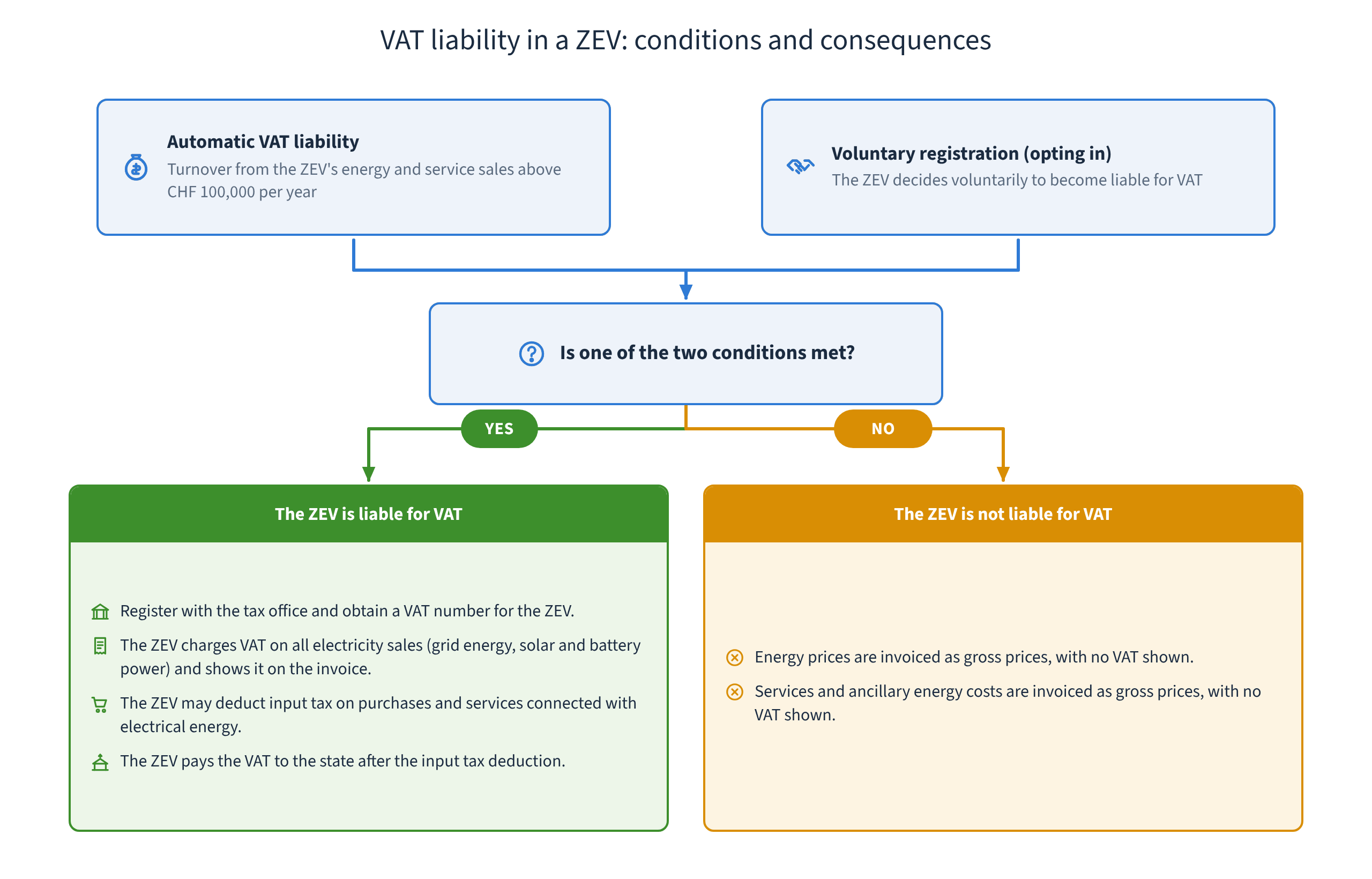
VAT liability can generally arise from the following conditions:
-
Turnover from the ZEV's sales of energy and services > 100'000 CHF / year --> Automatic tax liability
-
Through voluntary registration of the ZEV for VAT liability (opting for taxation of the ZEV)
In both cases, this must be registered with the tax office and a VAT number must be obtained for the ZEV.
If either of the two applies, the following happens with regard to the ZEV:
The ZEV is liable for VAT:
-
The ZEV charges VAT on all electricity sales (grid energy as well as solar and battery power) and shows it on the invoices.
-
The ZEV is entitled to deduct input tax on purchases and services related to electrical energy.
-
The ZEV must pay the VAT to the state after deducting input tax
The ZEV is not liable for VAT:
-
Energy prices are billed at gross prices without VAT information
-
Services and ancillary energy costs are billed at gross prices without VAT information
Is there VAT liability on heat / water and ancillary costs?
This question can only be answered based on the way these energies are sold and the relationship and mandate with respect to the property + the questions of turnover and opting for taxation.
Case 1 (see details below): Are the energies produced in the property or purchased by the landlord and then distributed? --> Central heating, district heating and allocation to the residents via ancillary costs
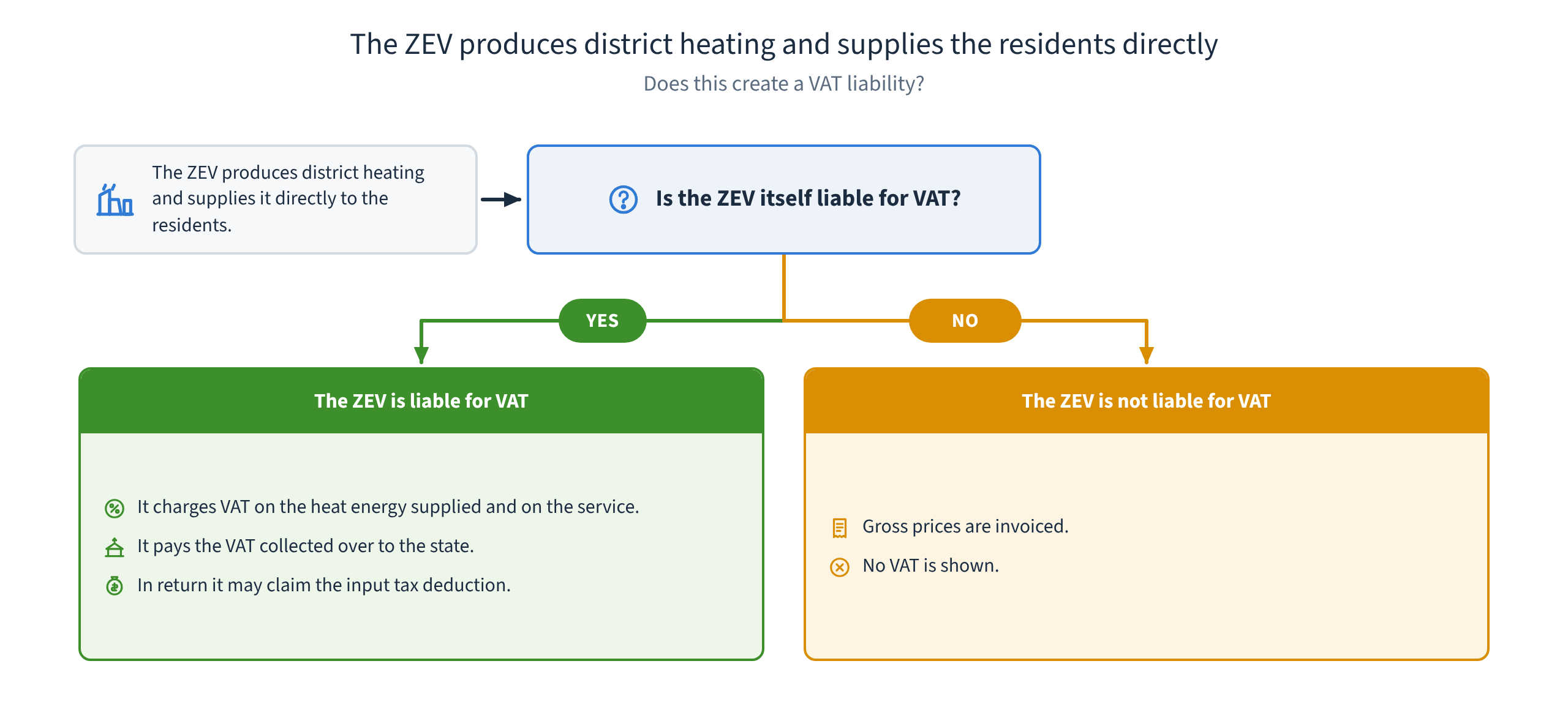
Case 2 (see details below): Are the energies produced and supplied directly by the ZEV to the tenant? --> Energy supplier situation, e.g. district heating?
Based on these two examples, it is clear that the relationships and references differ and can accordingly lead to different results.
Case 1:
Details:
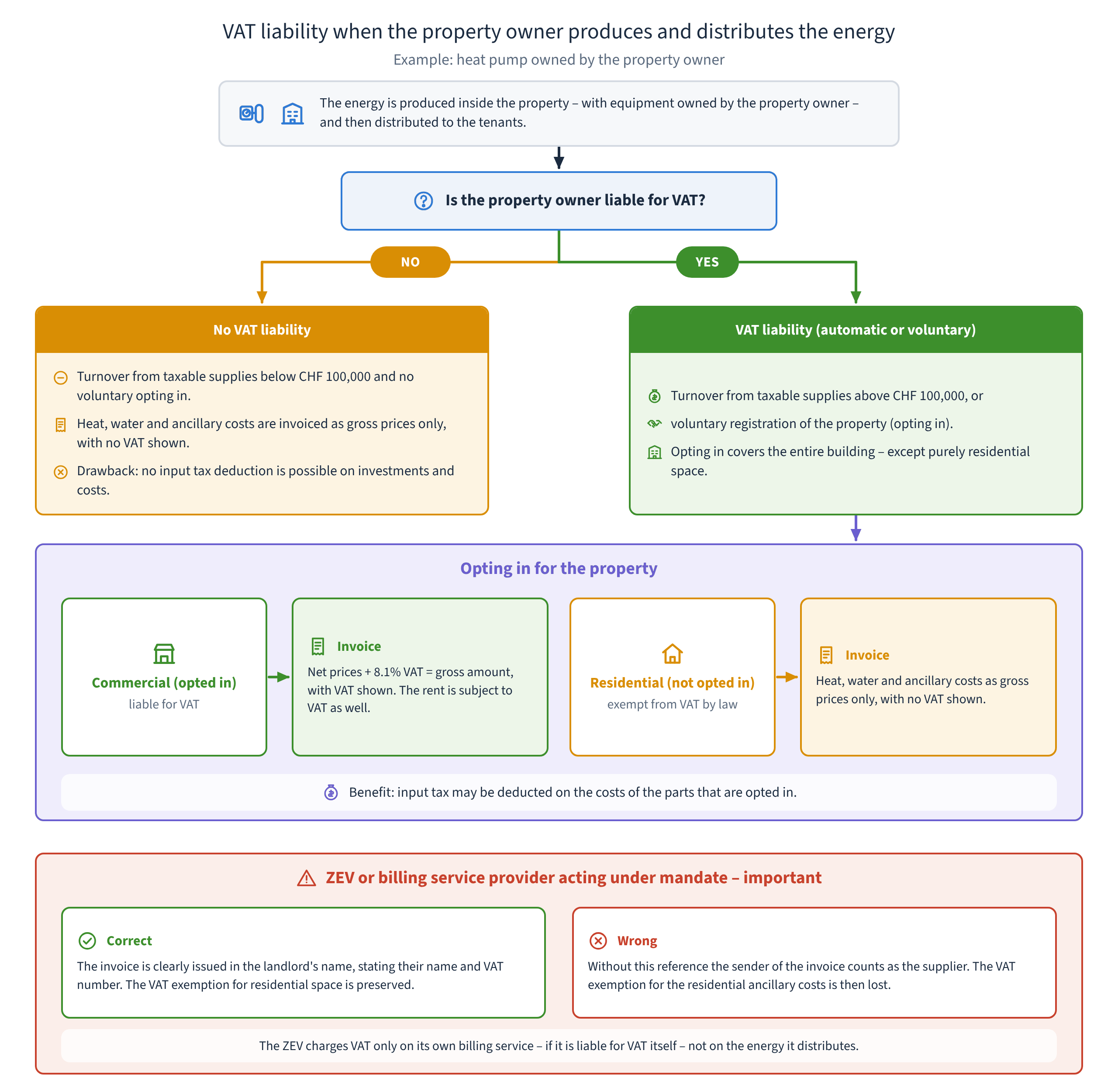
The energies are generated in the property by a heat pump with a hot water tank and then distributed within the properties. or The case of the STWEG (condominium owners' association), which purchases energy and then distributes it.
Since the energies were generated in the property by equipment owned by the property owner, the question now arises as to whether the property owner is liable for VAT. (Energies and ancillary costs)
The ZEV or billing service provider bills these energies as a service to the property owner under a mandate. The ZEV or billing service provider must charge VAT on the billing service itself, provided it is liable for VAT, but not on the energies and ancillary costs to be allocated.
In principle, the property owner can itself be liable for VAT for the same reasons:
-
Turnover from taxable supplies > 100'000 CHF / year --> Automatic tax liability Taxable supplies are, for example, the rental of holiday apartments or parking spaces not connected to apartment rentals. Services that are provided in-house are also taxable supplies. Normal apartment rents themselves are not taxable supplies.
-
Through voluntary registration of the property for VAT liability (opting for taxation)
The most common option is voluntary registration. Liability arising from turnover is rather rare, since renting out pure residential space is not a taxable supply.
Opting (partially opting) a property for taxation
The decision to opt a property for taxation lies with the owner of the property. It can be a smart move when renting out commercial space, as the businesses can then deduct the VAT as input tax.
If the decision to opt for taxation is made, the entire property owned by the same landlord is opted and voluntarily made subject to VAT.
This is important to understand, because it places all parts of the property owned by this landlord under VAT. The exception, by law, is pure residential space, which cannot be opted for taxation.
Example:
If the building with 4 units (2x commercial space, 2x residential space) is entirely owned by owner A and this owner opts for taxation, they are effectively partially opted for all parts of the property that are not pure residential space.
-
Commercial space 1 --> opted
-
Commercial space 2 --> opted
-
Residential space 1 --> not opted, because residential space is exempt from VAT
-
Residential space 2 --> not opted, because residential space is exempt from VAT
For all opted units, the following must now happen:
-
Show heat / water invoice amounts net incl. VAT. It is important to note here that the VAT for all components is aligned with the VAT rate of the rents. Even expenses with a reduced tax rate (2.6% for cold water) must then be taxed at the standard rate of 8.1%.
-
Show ancillary costs invoice amounts net incl. VAT.
-
Show the rent net incl. VAT! (When the property is opted for taxation, the rent also becomes subject to VAT)
For all non-opted units (residential spaces):
-
Heat / water invoice amounts at gross prices without showing VAT.
-
Ancillary costs invoice amounts at gross prices without showing VAT.
In addition to being liable for tax, the property owner is now also entitled to deduct input tax on all supplies relating to the opted parts of the property, but not on those relating to the non-opted parts.
If the ZEV or billing service provider acts under a mandate as the service provider for heat / water and ancillary costs, the following is important:
-
The invoice to the tenant must clearly show that the invoice was issued on behalf of the landlord. If this is not clearly stated, the sender of the invoice is deemed to be the issuer of the invoice. Since the invoices for rent and ancillary costs would then not come from the same issuer, the entitlement to VAT exemption for heat / water and ancillary costs is lost, as they are no longer regarded as part of the rent!
A note text: Invoicing and dispatch on behalf of your landlord XXXXXXXXXX If the landlord is liable for tax, with the landlord's VAT number.
Case 2: